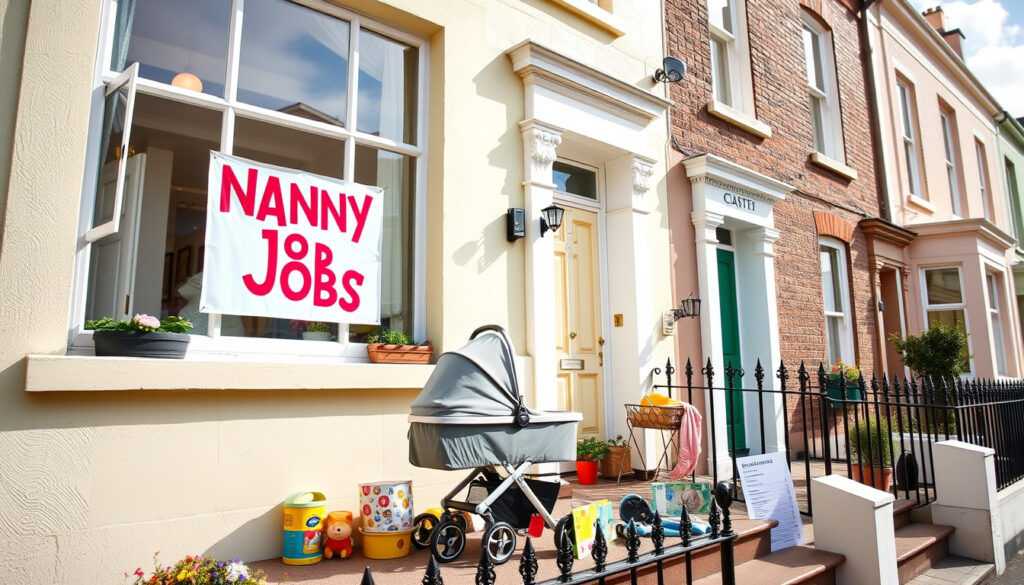
Nanny Jobs Near Me in Ireland: Dublin Salaries & Requirements
If you’ve been searching “nanny jobs near me” from anywhere in Ireland, you’re looking at one of Europe’s most active childcare markets — Dublin alone accounts for hundreds of postings at any given moment. Live-in roles can pay €2,070 to €3,280 gross per month on a full-time basis, according to Indeed.ie (major Irish job board), while part-time hourly rates on platforms like Babysits.ie typically range from €10 to €16 per hour. Below is a ground-level breakdown of what’s actually listed right now, what you’ll realistically earn, and where the entry points are if you’re starting out.
Live-in Nanny Jobs Dublin: 25+ openings · Dublin Nanny Job Volume: 53-55 on Babysits alone · Hourly Rate Range: €10-€16/hr · Key Platforms: Indeed.ie, SmartNanny.ie, Babysits.ie
Quick snapshot
- Dublin has 25+ live-in nanny postings on Indeed.ie (Indeed.ie (major Irish job board))
- Live-in roles earn €2,070-€3,280/month gross (Indeed.ie (major Irish job board))
- Babysits.ie lists 53-55 Dublin nanny positions (Babysits.ie (Irish family platform))
- Exact 2026 salary projections from official Irish government sources
- How many postings explicitly state “no experience required”
- Average nanny tenure or turnover rates in Ireland
- Rathcoole, Co. Dublin role starting September 2025 (SmartNanny.ie (Dublin nanny agency))
- Multiple ASAP starts across Killiney, Monkstown, and Swords (SmartNanny.ie (Dublin nanny agency))
- Flexible start date available for Foxrock, Co. Dublin position (SmartNanny.ie (Dublin nanny agency))
- South Dublin areas (Rathcoole, Foxrock, Killiney) show concentrated vacancy activity (SmartNanny.ie (Dublin nanny agency))
- North Dublin (Swords) has ASAP full-time openings for young children (SmartNanny.ie (Dublin nanny agency))
- Part-time and entry-level positions available across multiple platforms (SmartNanny.ie (Dublin nanny agency))
| Field | Details |
|---|---|
| Primary Locations | Dublin, Limerick, Ireland-wide |
| Key Job Types | Live-in, part-time, no experience |
| Salary References | €10-€16/hr (hourly); €2,070-€3,280/month (live-in) |
| Job Platforms | Indeed.ie, SmartNanny.ie, Babysits.ie |
| Typical Hours | 40 hours/week (Mon-Fri full-time roles) |
| Live-in Availability | Often requires 6-7 nights per week |
How much do nannies get paid in Ireland?
Pay varies significantly depending on whether you’re applying for a live-in position, a part-time hourly role, or a full-time live-out arrangement. The two most common structures are monthly salaries for live-in or full-time nanny contracts, versus hourly rates on a per-job or part-time basis.
Hourly vs monthly rates
Babysits.ie, which lists dozens of Dublin nanny positions, shows hourly rates ranging from €10 per hour for preschooler care up to €16 per hour for toddler and infant specialists (Babysits.ie (Irish family platform)). Care.com, another popular Irish platform, posts part-time roles in the €216 to €277 range for approximately 20 hours of weekly work (Care.com (international childcare platform)). If you work 20 hours per week at the lower end of the Babysits range, that translates to roughly €800 per month — considerably less than the full-time live-in brackets.
Hourly roles give you flexibility but no guaranteed income. Monthly salaries provide stability, but live-in positions demand 6 to 7 nights per week on-site — meaning your “free time” is bound to the household’s schedule.
Live-in nanny pay
Full-time live-in roles on Indeed.ie in Dublin command gross monthly salaries between €2,070 and €3,280, based on 35 to 48 working hours per week (Indeed.ie (major Irish job board)). That works out to roughly €11 to €17 per hour on a full-time equivalent basis — competitive with the upper end of Babysits’ hourly range, but with accommodation bundled in. An Indeed.ie advertisement at the higher end of that bracket offers “€2,070 to €3,134 gross per month for 35 to 48 hours work per week” (Indeed.ie (major Irish job board)).
Factors affecting salary
Your pay will shift based on location within Ireland, with Dublin roles generally offering higher rates than regional postings on platforms like SchoolDays.ie (SchoolDays.ie (Irish childcare portal)). Whether accommodation is included (live-in) or not (live-out) matters significantly. Experience level, number of children, and specific duties — such as school runs, meal preparation, or tutoring — also influence what families are willing to pay. QQI Level 6 qualifications are preferred for some care roles on Indeed (Indeed.ie (major Irish job board)), though the market does include positions that do not list formal qualification requirements.
Do you need qualifications to be a nanny?
This is where the market gets a little more demanding than the job listings might suggest. While some positions advertise as open to newcomers, a quick survey of current Dublin postings shows that most agencies and families prefer candidates with demonstrable childcare experience or relevant certifications.
Basic requirements
At a minimum, Irish families and agencies typically look for proof of reliability — often a clean Garda vetting certificate, references from previous childcare roles, and a willingness to commit to the household’s schedule. Many postings on SmartNanny.ie list “experienced & professional” or “extensive experience” as explicit requirements (SmartNanny.ie (Dublin nanny agency)). Driving is frequently listed as either essential or strongly preferred, particularly for roles that involve school runs.
Preferred certifications
QQI Level 6 qualifications are preferred for some care-related roles advertised on Indeed.ie (Indeed.ie (major Irish job board)). First Aid certification, food hygiene training, and childcare qualifications from FETAC or QQI can strengthen your application. Belgrave Agency, operating through Nanny.ie, notes that they have 28 years of experience matching candidates with families and can advise on salary negotiations and contract terms (Nanny.ie (Irish nanny placement agency)).
No experience entry points
The honest picture: most agencies and family postings currently require prior experience. However, live-in carer roles on Indeed — which blend childcare with elderly or disability care — may be more accessible to newcomers willing to commit to 6 or 7 nights per week on-site (Indeed.ie (major Irish job board)). Starting as a mother’s help, a part-time babysitter on Babysits.ie, or au pair work can build the experience foundation needed to move into full-time nanny roles.
No formal “no experience” nanny roles were explicitly listed on SmartNanny.ie at the time of research — every posting referenced prior childcare experience or professional qualifications. If you’re starting from zero, focus on building references through babysitting or part-time roles first.
Is working as a nanny worth it?
This depends heavily on your circumstances, lifestyle preferences, and what you compare the income against. For some people, the combination of accommodation, structured hours, and the emotional reward of childcare makes it a strong career choice. For others, the financial arithmetic and lifestyle trade-offs fall short.
Pros and benefits
Live-in roles in Dublin offer the most complete package: a gross monthly salary between €2,070 and €3,280, plus accommodation included — effectively removing your biggest monthly expense. Many full-time positions run Monday through Friday, 40 hours per week, with weekends typically free (SmartNanny.ie (Dublin nanny agency)). Roles in South Dublin areas like Killiney, Monkstown, and Foxrock sometimes include travel opportunities, as one SmartNanny posting describes “an amazing opportunity to work in Dublin and overseas with a young, fun and kind family in South Dublin” (SmartNanny.ie (Dublin nanny agency)).
Challenges and cons
The live-in arrangement means your home and your workplace are the same address — boundaries blur, and time off depends on the family’s schedule. Many Dublin nanny roles require availability during school holidays, which may not align with your own plans. The market is heavily skewed toward experienced candidates, which creates a chicken-and-egg problem for newcomers. Glassdoor.ie reports roughly 80 babysitter and nanny jobs listed across Ireland broadly (Glassdoor.ie (employment marketplace)), but the geographic concentration in Dublin means fewer opportunities in regional areas.
Salary vs cost of living
Against Dublin’s cost of living — particularly rent — a live-in salary of €2,070 to €3,280 per month with accommodation included looks relatively strong on paper. The same salary without accommodation would be significantly more compressed once housing costs are factored in. For comparison, roles at €10 to €16 per hour on a part-time basis, if you could secure 30 hours per week, would generate roughly €1,300 to €2,100 per month before tax — enough to live on in shared accommodation in Dublin, but with far less financial cushion than a live-in arrangement.
What qualifications do you need as a nanny?
Beyond the practical question of experience, there are specific credentials that Irish families and agencies actually look for. The answer is not one-size-fits-all — it shifts depending on whether you’re targeting a premium family placement through an agency or picking up part-time work through an online platform.
Essential skills
Garda Vetting is effectively non-negotiable — every legitimate family or agency will require it. First Aid training is frequently mentioned in postings as either required or strongly preferred. A clean driver’s licence is listed as essential for roles involving school pickups across South Dublin areas including Swords and Booterstown (SmartNanny.ie (Dublin nanny agency)). Beyond certifications, families value interpersonal maturity — one Monkstown posting specifically requests “a mature, experienced nanny” for after-school and travel coverage (SmartNanny.ie (Dublin nanny agency)).
Training options
QQI Level 5 or Level 6 Early Childhood Care and Education certifications are the most widely recognised formal qualifications in the Irish market. These are available through Further Education colleges across Ireland and typically take one to two years part-time. First Aid courses are offered by the Irish Red Cross and other providers over single-day or weekend formats. Food hygiene certificates can be completed online for modest fees and are worth having even if not explicitly required.
Employer expectations
SmartNanny.ie listings reveal a clear preference pattern: roles in Booterstown require “an experienced professional,” the Killiney role specifies a driver, and the Foxrock position looks for someone comfortable caring for two young children (SmartNanny.ie (Dublin nanny agency)). Agency-based placements through Nanny.ie tend to have the highest entry bar, as agencies vet candidates on behalf of families and prefer those with track records. Direct family postings on Babysits.ie are more varied — some families are open to first-timers, while others specify years of experience.
The qualification bar in Dublin is real but not insurmountable. Garda Vetting, a First Aid certificate, and driving experience open most doors. Formal childcare qualifications raise your profile with agencies and premium families, but platform-based work on Babysits.ie and Care.com provides a realistic entry route without them.
How much to charge for a nanny per hour?
If you’re a self-employed nanny setting your own rates, benchmarking against what the market actually pays is essential. The figures below come from active Irish job postings and represent what families are currently advertising.
Rate benchmarks
For part-time, live-out work in Dublin, the market range on Babysits.ie sits at €10 to €16 per hour depending on the child’s age and the complexity of duties (Babysits.ie (Irish family platform)). Roles involving infant care or multiple young children tend to command the higher end. On Care.com, part-time roles posting at €216 to €277 for 20 hours per week translate to roughly €10.80 to €13.85 per hour (Care.com (international childcare platform)), which aligns with the lower-to-mid Babysits range.
Regional variations
Dublin-based roles consistently show higher rates than regional postings in Limerick or elsewhere in Ireland. The concentration of dual-income professional families in Dublin — particularly in South Dublin suburbs like Rathcoole, Foxrock, Killiney, and Booterstown — drives demand and supports higher wage expectations (SmartNanny.ie (Dublin nanny agency)). North Dublin areas like Swords also show active full-time vacancy postings, though rate data for that specific area is less publicly available.
Live-in adjustments
When you factor in accommodation, a live-in rate of €2,070 to €3,280 per month for 35 to 48 hours of weekly work is effectively a combined salary and housing package (Indeed.ie (major Irish job board)). If you were to independently rent comparable accommodation in Dublin — typically €1,200 to €1,800 per month for a room in a shared property — the live-in value proposition becomes more compelling than the raw salary figure suggests.
Upsides
- Live-in roles in Dublin offer €2,070-€3,280/month plus accommodation
- 40-hour Mon-Fri schedules are common for full-time positions
- South Dublin (Rathcoole, Killiney, Foxrock) has concentrated vacancy activity
- QQI Level 6 qualifications can raise your profile with premium families
- Babysits.ie and Care.com provide accessible entry-level platforms
Downsides
- Most Dublin postings require prior childcare experience
- Live-in roles demand 6-7 nights per week on-site availability
- Part-time hourly work (€10-16/hr) offers limited income security
- Driving licence and own car required for many South Dublin roles
- Regional areas outside Dublin have significantly fewer postings
Finding nanny jobs near you in Ireland
With the salary landscape and qualification requirements mapped, here’s a practical path to actually landing a role. Dublin’s nanny market moves quickly — positions with ASAP start dates in Killiney, Monkstown, and Swords are actively listed right now (SmartNanny.ie (Dublin nanny agency)), while the Rathcoole role starting September 2025 gives you a longer lead time to prepare your application.
Step 1 — Identify your market tier
Match yourself to the right platform. Agency placements through SmartNanny.ie and Nanny.ie target experienced professionals with established references. Babysits.ie and Care.com accommodate a broader range of experience levels, including newcomers willing to build a profile over time. Indeed.ie captures both live-in salary roles and part-time hourly postings in one searchable interface.
Step 2 — Build your minimum viable profile
Before applying, ensure you have three things in place: a current Garda Vetting certificate, at least two verifiable childcare references, and a First Aid qualification. Without these, your application will be screened out at the first review regardless of your experience level. Babysits.ie profiles that include profile photos, response times, and detailed bio information receive more enquiries from families.
Step 3 — Target geography strategically
South Dublin suburbs — Rathcoole, Foxrock, Killiney, Booterstown, Monkstown — show the highest concentration of full-time nanny vacancies, according to SmartNanny.ie postings (SmartNanny.ie (Dublin nanny agency)). North Dublin (Swords) has active ASAP openings. If you are open to live-in work, Indeed.ie shows 25 or more live-in nanny and carer positions in Dublin and County Dublin at any given time (Indeed.ie (major Irish job board)). Regional candidates should check SchoolDays.ie and Nanny.ie for broader Ireland-wide listings.
Step 4 — Apply and follow up
Submit tailored applications rather than generic pitches. Reference the specific suburb, children ages, and any requirements mentioned in the posting. Roles specifying “ASAP” start should be followed up within 24 to 48 hours. The Booterstown full-time role lists Mon-Fri, 40 hours per week as the standard arrangement (SmartNanny.ie (Dublin nanny agency)) — confirm you can meet those terms explicitly in your application.
The nanny market in Dublin is real and active, but it is not a soft landing. The gap between “there are jobs available” and “you are qualified to apply” is bridged by experience, references, and credentials that take time to accumulate. Starting with part-time or babysitting work on Babysits.ie is the most accessible on-ramp if you are new to the field.
“An amazing opportunity to work in Dublin and overseas with a young, fun and kind family in South Dublin.”
— SmartNanny.ie, job posting for Foxrock, Co. Dublin
“Make 2025 Great For You! €2,070 to €3,134 gross per month for 35 to 48 hours work per week.”
— Indeed.ie, live-in nanny advertisement for Dublin
For candidates who have the experience and credentials Dublin families are looking for, the market offers genuine opportunity — not just in volume (25+ live-in postings on Indeed alone), but in the structure of the compensation. A live-in role at €2,070 to €3,280 per month with accommodation included compares favourably to the post-tax earnings of many other entry-level professional roles in Ireland. The trade-off is lifestyle: 6 to 7 nights per week on-site, school holiday coverage, and living where you work.
For those without experience, the path exists but requires a deliberate build. Start on Babysits.ie or Care.com, accumulate references, complete First Aid and Garda Vetting, and work toward a QQI Level 5 or 6 qualification to unlock the agency route. Dublin’s demand is sustained enough that the investment in credentials pays off within a year for many candidates.
Related reading: Adopt a Dog Near Me in Ireland · Dick’s Sporting Goods Near Me
Frequently asked questions
What jobs pay €20 per hour in Ireland?
Live-in nanny roles at the upper end of the salary bracket on Indeed.ie — around €3,280 per month for 48 hours per week — work out to roughly €17 per hour before tax. Health Care Supervisor roles in Dublin are listed in the €35,100 to €37,128 annual range on Indeed (Indeed.ie (major Irish job board)), which translates to approximately €17 to €18 per hour. Direct €20 per hour rates are less commonly advertised for standard nanny roles but may be achievable with specialist infant care credentials in high-demand periods.
What is the highest paid nanny?
The highest-paid standard nanny roles in Ireland are full-time live-in positions at the top of the salary bracket, around €3,280 gross per month on Indeed.ie (Indeed.ie (major Irish job board)). Roles involving multiple children, special needs care, or household management (nanny-housekeeper combinations) sometimes command premiums. Agency-placed premium family roles through Nanny.ie can negotiate above standard market rates for the right candidate.
What is the highest paid unskilled job in Ireland?
Live-in nanny roles at €2,070 to €3,280 per month rank among the better-paying entry-level options in Ireland when the accommodation component is valued. Care.com shows part-time roles at €216 to €277 for 20 hours per week (Care.com (international childcare platform)), which is modest but does not require formal qualifications. Care sector roles with QQI credentials and Health Care Supervisor positions on Indeed.ie reach €35,100 to €37,128 annually (Indeed.ie (major Irish job board)), placing experienced care workers above many non-degree roles.
How much is a nanny paid per month in Ireland?
Full-time live-in nanny salaries in Dublin range from €2,070 to €3,280 gross per month according to Indeed.ie postings (Indeed.ie (major Irish job board)). Part-time work on Babysits.ie at €10 to €16 per hour, if you secure 25 hours per week, would yield roughly €1,000 to €1,600 per month before tax. The live-in arrangement is the most financially competitive on a pure compensation basis when accommodation is factored in.
Is €3,000 a month a good salary in Ireland?
A gross monthly salary of €3,000 — approximately €36,000 per year — sits near the Health Care Supervisor salary range of €35,100 to €37,128 on Indeed.ie (Indeed.ie (major Irish job board)). As a live-in nanny figure with accommodation included, €3,000 gross per month is above average for the role. On a live-out basis in Dublin, €3,000 net after tax would leave you managing rent (€1,000 to €1,500 for a room in shared accommodation), making financial stability achievable but not generous.
What types of nanny jobs are available with accommodation?
Live-in nanny and live-in carer roles on Indeed.ie form the primary category of accommodation-included positions in Dublin (Indeed.ie (major Irish job board)). SmartNanny.ie lists at least one full-time live-in position in Killiney, Dublin with an ASAP start date (SmartNanny.ie (Dublin nanny agency)). These roles typically require 6 to 7 nights per week on-site availability and involve childcare duties alongside light household support.
Are there summer nanny jobs near me?
Summer and seasonal nanny roles are less prominently listed as a distinct category on Irish platforms compared to year-round full-time positions. Families in South Dublin areas — particularly Killiney, Monkstown, and Foxrock — may require nanny coverage during school holiday periods, which can translate to short-term contracts for candidates already working with those households. Babysits.ie and Care.com are the most likely sources for ad-hoc holiday-week or summer-specific postings, though these are not always labelled as seasonal roles.
More related posts
 Free APA 7 Citation Generator: Tool, Guide & Examples
 Matthew 6:33 Meaning: Seek First the Kingdom of God
 América vs Cruz Azul: Prediction, Lineups & Live Updates
 Howard County Judge Elkin Banned – Supreme Court Misconduct Ruling
 Taylor Swift Merch Store: Official Guide to Avoid Fakes
 Save A Lot Near Me: Locations, Hours & Weekly Deals
 Dawn of the Black Hearts Cover: Facts and History
 Patrick Schwarzenegger Movies & TV Shows: Full Filmography
