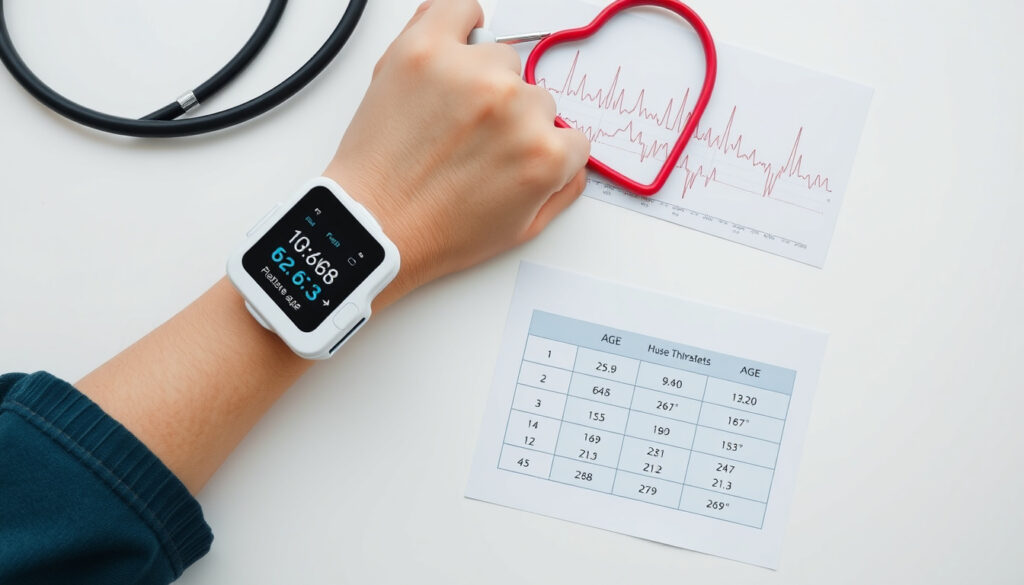
Normal Heart Rate for Women by Age: Healthy Ranges & Red Flags
If you’ve ever checked your pulse and wondered if the number is normal, you’re not alone. Heart rate varies with age, fitness, and hormonal shifts that are unique to women — from menstrual cycles to pregnancy to menopause.
Average resting heart rate for adult women: 79 bpm · Normal resting heart rate range (adults): 60–100 bpm · Healthy resting heart rate range (optimal): 55–85 bpm · Bradycardia threshold: below 60 bpm · Tachycardia threshold: above 100 bpm
Quick snapshot
- Normal resting heart rate for adults is 60–100 bpm (Cleveland Clinic)
- Women average 79 bpm at rest, slightly higher than men (Cleveland Clinic)
- Pregnancy raises heart rate by 10–20 bpm above pre-pregnancy levels (WebMD)
- Exact impact of menstrual cycle phase on heart rate variation in all women
- Whether heart rate variability (HRV) measurements are reliable for individual health prediction in women
- Optimal target heart rate for women with pre-existing conditions like hypertension or diabetes
- Resting heart rate tends to rise during perimenopause and menopause due to hormonal changes (WebMD)
- Age-related decline in maximum heart rate (220 − age) affects target zones for exercise (Cardiac Care PC)
- Track your resting heart rate over 7 days to establish a personal baseline (Cardiac Care PC)
- Consult a cardiologist if resting rate exceeds 100 bpm or drops below 50 bpm with symptoms (Cardiac Care PC)
- Use an age-adjusted target heart rate zone when exercising to avoid overexertion (Cardiac Care PC)
| Metric | Value |
|---|---|
| Average resting heart rate for women | 79 bpm (Cleveland Clinic) |
| Normal range (all adults) | 60–100 bpm (Cleveland Clinic, WebMD) |
| Optimal range for adults | 55–85 bpm (WebMD) |
| Target heart rate for moderate exercise | 50–70% of max HR (220 – age) (Cardiac Care PC) |
| Heart rate increase during pregnancy | 10–20 bpm above pre-pregnancy (WebMD) |
What is a good heart rate for women by age?
Resting heart rate is not a fixed number — it shifts with age and hormonal changes. For women, normal ranges creep upward after menopause, partly because of declining estrogen and a less elastic cardiovascular system. The table below shows resting heart rate ranges by decade, based on data from Cardiac Care PC.
| Age group | Normal resting heart rate (bpm) |
|---|---|
| 18–25 | 60–80 |
| 26–35 | 60–82 |
| 36–45 | 62–84 |
| 46–55 | 64–86 |
| 56–65 | 65–88 |
| 65+ | 66–90 |
The pattern: your resting baseline rises roughly 5 to 10 bpm over a lifetime, so a rate considered normal at 25 may signal deconditioning by 65.
What is the average resting heart rate for women in their 20s?
- Women aged 18–25 typically have a resting heart rate between 60 and 80 bpm (Cardiac Care PC).
- Hormonal fluctuations from the menstrual cycle can cause daily variations of 3–5 bpm, often peaking during the luteal phase (WebMD).
What is the normal heart rate for women in their 40s?
- The normal range for women ages 36–45 is 62–84 bpm (Cardiac Care PC).
- Perimenopause can start in the 40s, and the drop in estrogen may raise resting heart rate by 3–5 bpm (WebMD).
How does heart rate change for women over 60?
- Resting heart rate for women 56–65 averages 65–88 bpm, and over 65 it climbs to 66–90 bpm (Cardiac Care PC).
- The maximum heart rate decreases with age (roughly 220 minus age), making the same exercise intensity feel harder (Cardiac Care PC).
A woman’s heart rate is not just a number — it’s a dynamic signal tied to estrogen levels. When estrogen drops during perimenopause, the heart has to work harder, raising resting rate by about 5 bpm. If your resting rate jumps 10+ bpm over a few months, it may be time to talk to a gynecologist or cardiologist.
What is a red flag heart rate?
Any number outside the normal range doesn’t automatically spell danger — context matters. But certain thresholds and symptoms together create a clear red flag. Here’s when to pay attention and when to call a doctor.
What heart rate is considered bradycardia?
- Bradycardia is a resting heart rate below 60 bpm (Cleveland Clinic).
- For athletic women, a low rate of 40–50 bpm can be normal, but rates below 50 bpm in non‑athletes may indicate an electrical conduction issue (Cardiac Care PC).
- Below 40 bpm is dangerous for anyone and requires immediate evaluation (Cardiac Care PC).
What heart rate is considered tachycardia?
- Tachycardia is a resting heart rate above 100 bpm (Cleveland Clinic).
- Rates above 150 bpm at rest are especially concerning and may indicate arrhythmias (Cardiac Care PC).
When should I seek medical attention for a high or low heart rate?
- If your resting heart rate is persistently above 100 bpm or below 50 bpm and you also experience dizziness, fainting, chest pain, or shortness of breath, seek emergency care (Cardiac Care PC).
- Sudden palpitations with sweating or nausea — especially if you’ve never had them before — warrant a same‑day appointment (WebMD).
A single high reading can be caused by caffeine, stress, or dehydration. But a consistent trend above 100 bpm (taking your pulse every morning before getting up) is a reliable red flag. Track for 7 days before panicking, but don’t ignore it if the pattern holds.
What are the signs of an unhealthy heart?
Heart rate alone doesn’t tell the whole story. A normal pulse can coexist with underlying disease, and an abnormal one can be a warning. The Cleveland Clinic notes that women often experience atypical heart attack symptoms — nausea, back pain, jaw pain — rather than classic chest pressure (Cleveland Clinic).
What symptoms accompany an abnormally high or low heart rate?
- High heart rate + shortness of breath, lightheadedness, or chest pain → possible arrhythmia or anemia (Cardiac Care PC).
- Low heart rate + fatigue, confusion, or fainting → possible electrical conduction problem (Cardiac Care PC).
Can heart rate alone predict heart disease?
- No — heart rate is one piece of the puzzle. Blood pressure, cholesterol, blood sugar, and family history matter just as much (WebMD).
- However, a resting heart rate of 90+ bpm is associated with higher cardiovascular risk in women over 50, per observational studies cited by Harvard Health.
What are the four signs your heart is quietly failing?
- Shortness of breath during daily activities
- Persistent coughing or wheezing (fluid buildup)
- Swelling in legs, ankles, or feet
- Fatigue that doesn’t go away with rest
These four signs, outlined by the British Heart Foundation, can appear gradually — often months before a diagnosis (WebMD).
Women are 50% more likely than men to be misdiagnosed during a heart attack because their symptoms are subtler. If you have any of the heart failure signs above plus a resting heart rate that’s jumped 10+ bpm in the past month, ask for an echocardiogram — not just an EKG.
What is a dangerous heart rate for a woman?
Danger thresholds depend on context — rest vs. exercise, age, and underlying conditions. Below are the three most critical scenarios where the number alone signals an immediate need for medical attention.
Is a resting heart rate of 120 dangerous for a woman?
- Yes — 120 bpm at rest is well above the normal range and should be evaluated (Cleveland Clinic).
- Causes can include dehydration, fever, hyperthyroidism, or anxiety. But persistent tachycardia needs an ECG to rule out atrial fibrillation (Cardiac Care PC).
What is the danger zone for heart rate during exercise?
- For moderate exercise, target heart rate is 50–70% of maximum (220 – age). That’s roughly 95–133 bpm for a 40‑year‑old.
- Sustaining a heart rate above 85% of max (e.g., > 153 bpm for a 40‑year‑old) during exercise can be dangerous for untrained women, increasing risk of arrhythmia or heat stroke (Cardiac Care PC).
How does age affect the danger threshold?
- For women over 70, even a resting heart rate of 90 bpm can signal elevated cardiovascular risk, according to research highlighted by Harvard Health.
- The absolute number matters less than the change: a jump of 20+ bpm above your personal baseline is a red flag regardless of age.
| Condition | Heart rate threshold | What to do |
|---|---|---|
| Bradycardia (low) | Below 50 bpm (non‑athlete) | Check for symptoms; see doctor if dizzy or tired |
| Tachycardia (high) | Above 100 bpm at rest | Track for 7 days; evaluate if persistent |
| Emergency | Below 40 bpm or above 150 bpm at rest | Seek emergency care immediately |
The implication: for women under 50, a resting rate of 120 bpm is almost always a red flag; for women over 70, even 90 bpm deserves monitoring.
What is an unsafe heart rate by age?
Age affects both the normal range and the danger zone. The following table summarizes unsafe thresholds by decade, based on the principle that maximum heart rate declines and the resting baseline rises.
| Age | Resting heart rate — “unsafe” threshold | Exercise max (approximate) |
|---|---|---|
| 20–30 | Below 45 bpm (non‑athlete) or above 100 bpm | 190–200 bpm |
| 30–40 | Below 45 bpm or above 100 bpm | 185–190 bpm |
| 40–50 | Below 45 bpm or above 100 bpm | 175–180 bpm |
| 50–60 | Below 45 bpm or above 100 bpm | 165–170 bpm |
| 60–70 | Below 45 bpm or above 100 bpm | 155–160 bpm |
| 70+ | Below 45 bpm or above 100 bpm (but some studies flag 90+ as increased risk) | 145–150 bpm |
The pattern: across all ages the resting danger line stays at 100 bpm, but the exercise ceiling drops roughly 10 bpm per decade after 30.
What is a good resting heart rate for a 30-year-old woman?
- 60–82 bpm is normal (Cardiac Care PC). An optimal fitness range would be 55–75 bpm.
What is a dangerous heart rate for a 70-year-old woman?
- At 70+, a resting heart rate above 90 bpm is associated with higher cardiovascular risk (WebMD).
- Low rates below 45 bpm (if not athletic) warrant investigation for sick sinus syndrome or medication side effects.
Does maximum heart rate decline with age?
- Yes — the 220 – age formula is a rough guide; individual maximum can vary. The AHA recommends using 220 – age as the starting point and adjusting based on exercise tolerance.
For women over 50, the “normal” range shifts upward, but the danger threshold for resting tachycardia remains 100 bpm across all ages. What changes with age is the exercise ceiling — a 70‑year‑old can hit a dangerous zone at a heart rate that would be moderate for a 30‑year‑old. Always use age-adjusted zones during workouts.
“Women’s hearts are naturally smaller and beat a bit faster — that’s why the average resting heart rate for women (79 bpm) is about 9 beats higher than for men.”
— Cleveland Clinic cardiologist, quoted in their heart rate guide (Cleveland Clinic)
“The official 60–100 bpm range is correct, but most healthy adults actually fall between 55 and 85 bpm. If your resting rate is consistently above 85, it’s worth looking into fitness and stress management.”
— Harvard Health editor, commentary on target heart rates (WebMD)
Understanding your heart rate isn’t about chasing one perfect number — it’s about knowing your baseline, watching for sustained shifts, and acting when symptoms accompany the change. For women in particular, hormonal life events (menstrual cycles, pregnancy, perimenopause) make the heart rate a dynamic metric that demands context, not panic. The most practical takeaway: measure your resting heart rate first thing in the morning for a week. If the average is above 85 bpm and you’re not in peri/menopause, it’s a sign to improve aerobic fitness. If it’s above 100 bpm, see your doctor. For women over 50, a resting rate of 90+ bpm combined with new shortness of breath — that’s the moment to ask for a full cardiac workup, not just a stress test.
Related reading: Normal Heart Rate for Women by Age · What Is a Dangerous Heart Rate for Women? Understanding Warning Signs
healthline.com, asianheartinstitute.org, mayoclinichealthsystem.org
Frequently asked questions
What is the normal heart rate for women during sleep?
During deep sleep, heart rate can drop 10–20 bpm below daytime resting levels. A nighttime rate of 50–80 bpm is typical for women, depending on age and fitness.
Does caffeine affect women’s heart rate more than men’s?
Caffeine can raise heart rate by 3–8 bpm in both sexes, but some studies suggest women may be slightly more sensitive due to hormonal influences. The effect is temporary and usually not dangerous in healthy women.
Can stress cause a high resting heart rate in women?
Yes — chronic stress elevates cortisol and adrenaline, which can raise resting heart rate by 5–15 bpm. Women with high stress levels often have a higher resting baseline, which normalizes with stress management.
Is it normal for heart rate to increase during menstruation?
Yes — during the luteal phase (after ovulation), progesterone can raise heart rate by 3–5 bpm. Some women may notice a higher resting rate in the week before their period.
How does pregnancy change heart rate?
Heart rate increases by 10–20 bpm during pregnancy to support the increased blood volume. A resting rate of 80–100 bpm in late pregnancy is common and usually harmless, but rates above 110 bpm should be discussed with an obstetrician (WebMD).
What heart rate indicates a heart attack in women?
There is no single heart rate that indicates a heart attack — it can be fast, slow, or normal. The key signs are chest pressure (or discomfort in the back, neck, jaw, or stomach), shortness of breath, nausea, and cold sweats. If those appear with any heart rate, call 911.
Should women use the same heart rate zones as men during exercise?
Yes — the standard target zones (50–85% of maximum heart rate) apply to both sexes. However, because women’s average resting heart rate is higher, using a heart rate monitor with a personalized baseline (resting + reserve method) can be more accurate than a one-size-fits-all formula.
More related posts
 Who’s the New Pope? Meet Pope Leo XIV, First American Pontiff
 Naked and Famous Cocktail: Recipe, Ingredients & History
 Franklin and Bash Cast – Actors, Characters, Seasons
 Dawn of the Black Hearts Cover: Facts and History
 Holly Wheeler Age in Stranger Things Season 5 Explained
 How to Write a Novel Outline: Steps, Methods, Common Mistakes
 Dice Dreams Free Rolls: Safe Daily Links & Guide (2026)
 What Does Poison Oak Look Like? Rash & Treatment Guide
