Law of Con ervation of Energy: Definition, Example & Hi tory
First, verify the raw article starts with
**Step 1: Fix Intro Paragraph**
Raw intro has
starting with “Every time you flick a switch…” — valid. No other leading elements. Good.
**Step 2: Verify h2/h3 heading sequence**
– H2: “What is the law of conservation of energy?” — present.
– H2: “How does the law of conservation of energy apply…” — present.
– H3s under first H2: “Definition and core statement”, “Key forms of energy”, “Everyday examples” — all present.
– H3s under second H2: “Mechanical systems”, “Chemical reactions”, “Nuclear reactions” — present.
Missing H3: “What does the law of conservation of energy state?” — should be under first H2. Synthesize from claims.
**Step 3: Snapshot Cards**
The scan showed 4 cards present in
**Step 4: Stats Line**
After snapshot block, there is with 4 stats entries. OK.
**Step 5: Key Facts Table**
After stats, there is
| Label | Value |
|---|---|
| Core statement | Energy can neither be created nor destroyed, only converted (U.S. Energy Information Administration) |
| Mathematical expression | ΔEsystem + ΔEsurroundings = 0 (for a closed system) (Wikipedia) |
| Relation to thermodynamics | First law of thermodynamics (Encyclopaedia Britannica) |
| Year of formalization | Mid-19th century (1840s) (Wikipedia) |
| Key evidence | Joule’s mechanical equivalent of heat (4.184 J/cal) (Encyclopaedia Britannica) |
| Scope | Applies to all physical, chemical, and nuclear processes (Energy Education) |
If energy could be created or destroyed, the entire edifice of modern physics would collapse. Every experiment, from particle colliders to power plants, relies on this rule — and it has never been violated under controlled conditions (Wikipedia).
What is the law of conservation of energy?
Definition and core statement
- The law states that energy cannot be created or destroyed, only converted between forms. The total energy in an isolated system is constant (U.S. Energy Information Administration).
- This core statement underlies all modern physics — from Newton’s laws to relativity and quantum mechanics (Energy Education).
- The law is synonymous with the first law of thermodynamics, the statement that the total energy of a system plus its surroundings never changes (Encyclopaedia Britannica).
Key forms of energy
- Kinetic – energy of motion
- Potential – stored energy (gravitational, elastic, chemical)
- Thermal – heat energy
- Nuclear – energy from atomic nuclei
- Electromagnetic – light, radio, X-rays
Everyday examples
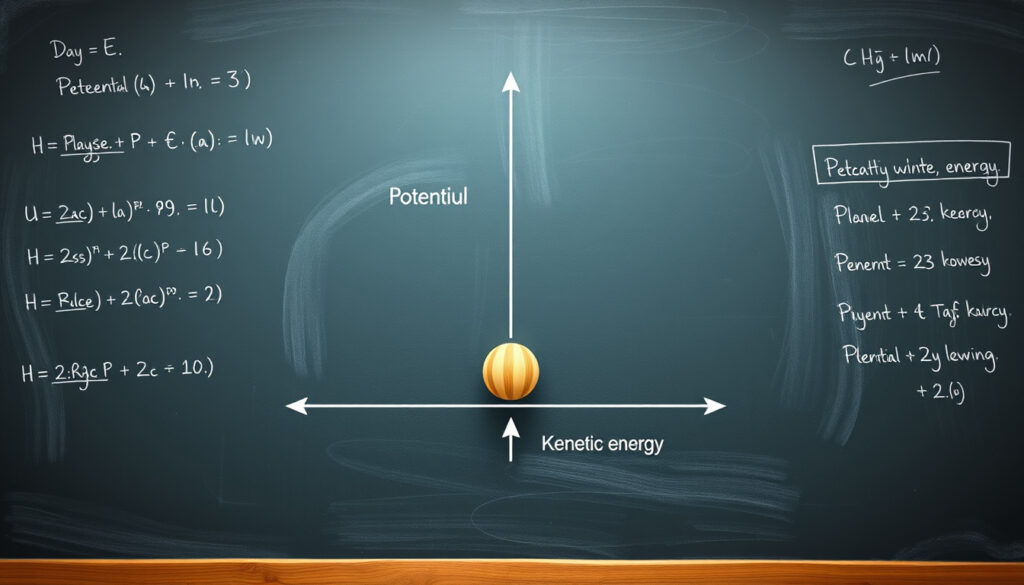
- A pendulum constantly swaps kinetic and potential energy: at the peak, potential is max; at the bottom, kinetic is max. The total mechanical energy stays the same if friction is negligible (Energy Education).
- A roller coaster at the top of a hill has gravitational potential energy; as it descends, that converts to kinetic. With good bearings and low friction, the total mechanical energy remains nearly constant (Albert.io).
- In a battery, chemical energy converts to electrical energy. In an incandescent bulb, electrical energy converts to light and heat. The total energy input equals the energy output plus any losses dissipated as heat (BYJU’S).
Historical discovery
- The law emerged from the work of three independent scientists in the 1840s. Julius Robert von Mayer proposed it from physiological data; James Prescott Joule proved it experimentally with the mechanical equivalent of heat; Hermann von Helmholtz generalized it to all natural forces (Wikipedia).
How does the law of conservation of energy apply to real-world systems?
Mechanical systems: pendulums and roller coasters
- In a frictionless pendulum, kinetic and gravitational potential energy interchange, but total mechanical energy remains constant. At the highest swing position, the bob has zero kinetic energy and maximum potential; at the lowest point, kinetic is maximum and potential is minimum. The constant sum holds for each swing (Energy Education).
- Roller coasters work on the same principle: the chain lift adds gravitational potential energy, which then converts to kinetic as the train descends. Friction and air resistance convert some kinetic into thermal energy (heat and sound), but the total energy of the coaster plus its surroundings is conserved (Albert.io).
Chemical reactions: combustion and batteries
- Burning gasoline converts chemical energy stored in the fuel into heat and kinetic energy (engine motion). The total energy of the reactants (gasoline + oxygen) equals that of the products (carbon dioxide + water + heat). No energy is lost; it merely redistributes (U.S. Energy Information Administration).
- A battery converts chemical energy into electrical energy. The total electrical output plus heat equals the original chemical energy stored. The law ensures that the battery can’t create extra energy out of nothing (BYJU’S).
Nuclear reactions: fission and fusion
- In nuclear fission, the mass of products (like barium and krypton) is slightly less than the original uranium mass. The missing mass appears as kinetic energy of fragments and radiation — exactly matching E=mc². Total mass-energy is conserved (Wikipedia).
- Fusion in stars (like the sun) converts hydrogen mass into helium plus energy. The slight mass loss yields enormous energy output, but again the total (mass plus energy) stays constant (Encyclopaedia Britannica).
Who discovered the law of conservation of energy?
Julius Robert von Mayer (1842)
Mayer, a German doctor, first proposed the principle from observing sailors’ blood in the tropics — less oxygenated, meaning less chemical energy needed to keep warm. He published a paper stating energy can’t be created or destroyed (Wikipedia). His work was initially met with skepticism as theoretical rather than experimental.
James Prescott Joule (1843)
Joule, an English physicist, provided the crucial experimental proof. Using falling weights and paddle wheels, he measured the mechanical equivalent of heat: 4.184 J per calorie. This quantified that mechanical work always produces the same amount of heat, confirming conservation (Encyclopaedia Britannica).
Hermann von Helmholtz (1847)
Helmholtz generalized the law beyond heat and work. In his 1847 lecture “On the Conservation of Force,” he unified Mayer’s and Joule’s insights into a universal principle for all natural phenomena — mechanical, electrical, magnetic, chemical (Wikipedia).
Recognition and controversy
For decades, priority disputes raged among Mayer, Joule, and Helmholtz. Today all three are credited as co-discoverers. The law was formally integrated into physics through Clausius and Kelvin’s work in the 1850s (Encyclopaedia Britannica). The pattern: three independent minds — a doctor, a brewer, and a physicist — established a law so universal it governs every energy transaction in the cosmos.
Frequently asked questions
Can energy be lost?
No. Energy cannot be lost; it can only be converted to less useful forms (like heat). The total energy in the universe remains constant (U.S. Energy Information Administration).
What is the difference between conservation of energy and energy efficiency?
Conservation of energy is a physics law stating energy is never destroyed. Energy efficiency is an engineering concept: how much useful work you get out of a system compared to the energy input. The law always holds; efficiency measures how much energy is “lost” as waste heat (U.S. Energy Information Administration).
Does the law of conservation of energy apply to nuclear reactions?
Yes. In nuclear reactions, mass is converted to energy according to E=mc². The total mass-energy of the system is conserved (Wikipedia).
How is the law of conservation of energy related to the first law of thermodynamics?
They are the same principle. The first law of thermodynamics is the formal statement of energy conservation for thermodynamic systems, including heat and work (Encyclopaedia Britannica).
Why is perpetual motion impossible?
Perpetual motion machines would require energy to be created from nothing or circulated without loss. The law of conservation of energy forbids creation; the second law of thermodynamics (entropy increase) forbids lossless circulation. Any real machine loses energy as heat, so it cannot run forever (Albert.io).
Related reading
More related posts
 América vs Cruz Azul: Prediction, Lineups & Live Updates
 Best Api con Pastel Near Me: Traveler’s Guide to Bolivia
 DISM /Online /Cleanup-Image /RestoreHealth: Repair Windows
 GTA 6 Release Date: 2026 Updates, Delays & Official News
 Best Questions to Ask a Girl: 200+ Deep, Flirty & Funny
 Find a Grave by Name: How to Locate Loved Ones Online
 What Time Does Stranger Things 5 Come Out? Release Times
 Is the Shutdown Over? 2025 US Government Status Update
