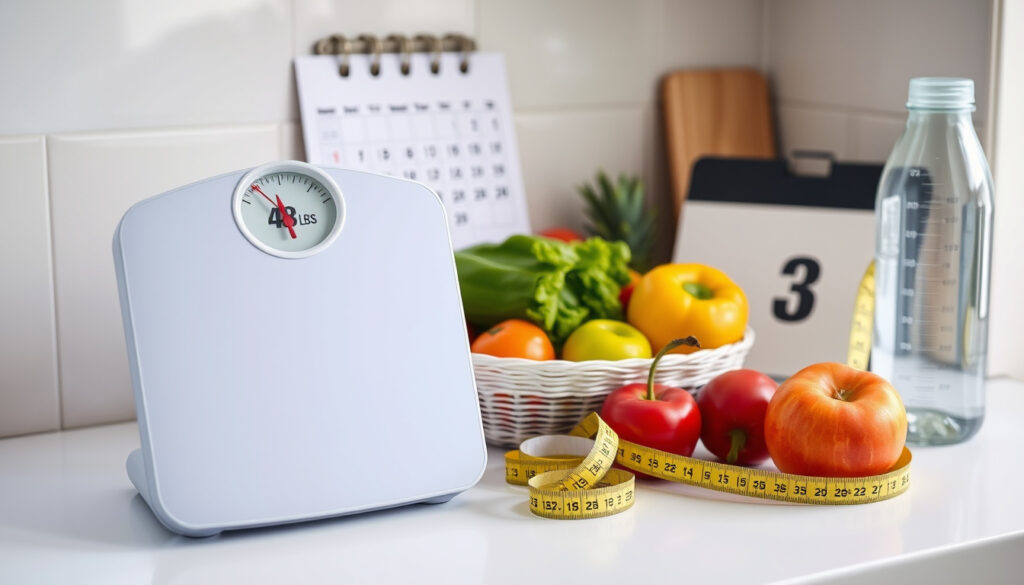
How Much Weight Can You Lose in a Month? 4-8 lbs Safely
If you’ve ever typed “how much weight can you lose in a month” into a search bar, you’re not alone. Millions of people set weight-loss goals each month, and many end up chasing numbers that aren’t realistic—or healthy. The truth is, there’s a well-established range that major health institutions agree on, and it may be more modest than the viral transformations you’ll see online.
Safe weekly loss: 1-2 pounds · Safe monthly loss: 4-8 pounds · Max healthy per week: 0.45-0.9 kg · Vinmec guideline: 1.6-3.6 kg per month · Realistic monthly range: 2-4 kg
Quick snapshot
- 1-2 lbs/week safe per CDC and NHLBI (CDC, NHLBI)
- 4-8 lbs/month through diet and exercise (Healthline)
- Exact feasibility of 20 lb/month without medical supervision
- Individual variation in drug-assisted outcomes
- Focus on sustainable habits over crash diets
- Medical supervision required for GLP-1 drugs
A cross-section of leading health authorities reveals a clear consensus on sustainable weight-loss rates.
| Source | Recommended rate | Authority |
|---|---|---|
| CDC | 1-2 lbs/week | Primary US health agency |
| NHLBI | 1-2 lbs/week, 5-10% over 6 months | Federal heart/lung/blood institute |
| Healthline | 4-8 lbs/month | Medical information platform |
| Cleveland Clinic | 1-2 lbs/week, 4-8 lbs/month | Academic medical center |
| Vinmec | 0.45-0.9 kg/week (1.6-3.6 kg/month) | International hospital network |
| Nutrition.gov | 1-2 lbs/week | US government nutrition resource |
| Mayo Clinic | 6-10 lbs in 2 weeks (Lose It! phase) | Top-ranked medical institution |
| PMC NCBI | 1000-1500 cal/day, 0.8 g/kg protein | Peer-reviewed research database |
Is it possible to lose 5 kg in a month?
Losing 5 kg (about 11 pounds) in a month pushes beyond the 4-8 pound monthly range that most health authorities recommend. The Vinmec medical network notes that Dr. Elizabeth Lowden, an endocrinologist, sets the safe weekly guideline at 0.45-0.9 kg, which works out to roughly 1.6-3.6 kg per month. That’s notably lower than 5 kg.
Safe rates from experts
The CDC and NHLBI both settle on 1-2 pounds per week as the standard for safe weight loss. Over a full month, that comes to 4-8 pounds. The Healthline editorial team, citing these same federal sources, frames 4-8 pounds monthly as the healthy target for most adults.
Dr. Walter Willett from Harvard advises aiming for half a pound to one pound per week until you’ve lost 5% of your body weight—a gradual approach that beats short bursts you can’t maintain.
Factors affecting loss
Not everyone loses at the same pace. According to Windermere Medical, the rate depends on your starting weight, age, gender, activity level, and metabolism. Someone carrying significantly more weight may see faster initial losses, but the rate typically slows as the body adjusts.
Starting weight is the dominant factor in early-rate variation. A person starting at 250 pounds will often lose faster in the first month than someone starting at 150 pounds—purely because their caloric deficit is larger relative to their total energy expenditure.
Those carrying significantly more weight have a larger caloric deficit relative to their total energy expenditure, which can produce faster initial losses.
Can a person lose 20 pounds in one month?
Twenty pounds in a month equals roughly 5 pounds per week—more than double the expert-recommended maximum. The Advanced Internal Medicine practice warns that losing more than 4-5 kg (about 8-11 pounds) per month without medical supervision risks nutritional deficiencies, muscle loss, gallstones, hormonal imbalances, and a slowed metabolism. That’s the clinical floor, and 20 pounds sits well above it.
Risks of rapid loss
The PMC journal article on obesity management notes that very-low-calorie diets under 800 kcal per day should only be followed with medical monitoring—not as a routine approach. Without that oversight, the body can enter survival mode, breaking down muscle tissue for energy and triggering electrolyte imbalances.
Realistic maximums
The Mayo Clinic’s Lose It! phase allows up to 6-10 pounds in two weeks for certain dieters, but that’s a structured, short-term program, not a sustainable monthly target. Reddit community reports on weight loss forums show that people achieving 20+ pound monthly losses typically combine extreme caloric restriction with intense exercise—and many report regaining the weight shortly after. The Cleveland Clinic puts it plainly: faster than 1-2 pounds per week is not recommended.
Crash diets that strip muscle can leave you lighter but flabbier-looking, even if the scale number improves.
How did Kim Kardashian lose 16 lb in 3 weeks?
Kim Kardashian’s widely reported 16-pound loss in three weeks (roughly 1.5 pounds per day) made headlines as a extreme case. Obesity medicine specialists who have commented publicly on this case note that such rapid loss in someone of her starting weight is not achievable through diet and exercise alone—it typically requires severe caloric restriction, significant fluid loss, or medical intervention.
Methods used
Public reporting and tabloid coverage suggested Kardashian used a combination of a “teatox” regimen, extreme carb restriction, and multiple daily workouts to achieve the initial drop. Some observers speculated she may have used prescription medication, though this was never confirmed. What is clear from the timeline is that much of the early loss was water weight—a pattern the Vinmec blog explicitly confirms: “First week may show 2.2-5 kg loss due to water and glycogen, then slows.”
Expert analysis
Board-certified obesity specialists have noted that for someone in the normal-to-overweight BMI range, a 16-pound loss in three weeks is neither sustainable nor healthy. The Cleveland Clinic warns against pursuing weight loss faster than 1-2 pounds weekly, and the Harvard Health editorial quotes Dr. Walter Willett: “A slow reduction is better than a quick reduction over a few weeks, which you probably can’t maintain.”
Extreme water-weight losses like Kardashian’s are often followed by rapid regain when normal eating resumes. For the average person following standard guidelines, 4-8 pounds per month is the realistic ceiling—not the floor.
Is 10 lb weight loss noticeable?
Yes—10 pounds is often visible, especially depending on where your body stores fat and your starting frame. Body composition matters as much as the scale number. Losing 10 pounds of pure fat looks different than losing 10 pounds that includes water weight and muscle.
Visual changes
On an average adult frame, losing 10 pounds can show as a looser fit in clothing, a more defined jawline, and reduced abdominal bulge. The effect is more pronounced in someone who starts at a higher weight, where 10 pounds represents a smaller percentage of total mass. For someone beginning at 200 pounds, 10 pounds is 5% of body weight—the same target the NHLBI recommends as an initial healthy loss goal.
If you’re exercising while dieting, pay attention to how your clothes fit and take progress photos—scale weight alone can be misleading when muscle preservation is part of the goal.
Muscle weighs more than fat by volume, so two people at the same weight can look very different.
Body composition factors
The PMC research on obesity notes that high-protein diets help preserve lean mass during weight loss, which means the scale might not drop as fast, but the visual results improve.
Crash diets that strip muscle can leave you lighter but flabbier-looking, even if the scale number improves.
Conversely, crash diets that strip muscle can leave you lighter but flabbier-looking.
How much weight can you lose in a month with exercise?
Exercise adds a meaningful boost to weight loss, but it works best in combination with dietary changes, not instead of them. The American Heart Association emphasizes balancing caloric intake reduction with increased physical activity for sustainable loss.
Diet and exercise combo
A combined approach can push you to the upper end of the 1-2 pounds per week range. According to Windermere Medical, creating a 500-1000 calorie daily deficit through both eating less and moving more yields about 1-2 pounds of weekly loss. The American Heart Association recommends this balanced approach as the foundation of any healthy weight-loss plan.
Walking 30 minutes a day burns roughly 150 calories; adding that to a 350-calorie daily food reduction creates a 500-calorie daily deficit—about 1 pound of weekly loss from exercise alone.
Drug-assisted like Zepbound
GLP-1 receptor agonists like semaglutide (Ozempic, Wegovy) and tirzepatide (Zepbound, Mounjaro) have changed the conversation about weight-loss velocity. Under medical supervision, patients on these drugs have reported 10-20 kg losses over three months, according to Advanced Internal Medicine. That translates to roughly 7-15 pounds per month—well above the standard guideline—but the mechanism works by reducing appetite and food noise, not through extreme restriction.
These medications require a prescription and medical oversight. Side effects include nausea, vomiting, and potential thyroid risks. They are not appropriate for people with normal BMI seeking cosmetic weight loss.
Steps: How to lose 4-8 pounds this month safely
- Calculate your baseline: Use an online TDEE (total daily energy expenditure) calculator to estimate how many calories you burn daily.
- Set a modest deficit: Subtract 500-750 calories from your daily maintenance needs. This creates a 0.5-0.75 kg weekly loss without triggering extreme hunger.
- Prioritize protein: Aim for at least 0.8 grams of protein per kilogram of ideal body weight per day, per PMC NCBI guidelines.
- Add resistance training: Preserving muscle mass keeps your metabolism higher. Even 2-3 sessions per week of bodyweight exercises helps.
- Walk more: UC Davis Health recommends weighing weekly, eating fewer calories than you burn, and increasing activity.
- Weigh once a week: Daily fluctuations can be demotivating. Weekly weigh-ins smooth out water-weight noise.
- Expect week-one dips: The Vinmec team notes that the first week may show 2.2-5 kg of loss from water and glycogen depletion—then the rate normalizes.
— Dr. Walter Willett, Harvard T.H. Chan School of Public Health
“A slow reduction is better than a quick reduction over a few weeks, which you probably can’t maintain.”
— Dr. Elizabeth Lowden, Endocrinologist, Northwestern Medicine
“If you want to lose 0.5 kg per week, you would need to consume approximately 3,500 fewer calories than you burn.”
Upsides
- 1-2 lbs/week is achievable without extreme sacrifice
- Gradual loss more likely to stay off long-term (CDC, NHLBI)
- Preserves muscle and metabolic function
- Reduces risk of gallstones, nutritional deficiencies
- Builds sustainable habits instead of crash-cycle patterns
Downsides
- Results feel slow compared to crash-diet claims
- Initial motivation may wane before visible changes appear
- Requires consistent tracking and meal planning
- Celebrity transformations create unrealistic expectations
- Drug-assisted options require medical supervision and cost
For most adults, the 4-8 pounds per month range isn’t glamorous, but it’s the only pace that works with your body’s biology rather than against it. The CDC, NHLBI, and Cleveland Clinic all agree: slow and steady doesn’t just win the race—it finishes it.
Related reading: How Many Ounces in a Pound · 6 Ft in Inches
Recommended monthly losses of 4-8 pounds generally align with safe weekly weight loss limits of 1-2 pounds to ensure sustainability and health.
Frequently asked questions
How to tell if your body is burning fat?
Signs include sustained energy levels (not crashing), reduced hunger between meals, and fat loss from stubborn areas like the abdomen. Ketone breath (a fruity smell) can indicate fat burning during low-carb diets. Scale weight loss alone doesn’t distinguish fat from water.
What’s the worst carb for belly fat?
Refined carbohydrates—white bread, pastries, sugary drinks—are the biggest contributors to visceral abdominal fat. The PMC research notes that refined carbs spike insulin, which drives fat storage around the midsection.
Which body part loses fat first?
Fat loss follows a genetically determined pattern, but most people notice facial and upper-body definition first, then the midsection, then the hips and thighs last. There’s no way to spot-reduce—overall caloric deficit determines where fat comes off.
Can I lose a stone in 3 weeks?
A stone equals 14 pounds. Losing 14 pounds in 3 weeks (roughly 4.7 pounds per week) is double the safe maximum. Most people who attempt this regain the weight within months. The Mayo Clinic Lose It! phase allows 6-10 pounds in two weeks maximum—and that’s a structured program, not a DIY target.
What Kardashian took Ozempic?
Kim Kardashian has never publicly confirmed using GLP-1 medications. Tabloid speculation centered on Ozempic (semaglutide) after her rapid 2023 transformation, but no verified reporting has confirmed this. The Advanced Internal Medicine practice notes that semaglutide under supervision yields 10-20 kg over three months.
How much weight can you lose in a month on GLP-1?
Clinical data from supervised patients shows 10-20 kg (22-44 pounds) over three months on semaglutide, per Advanced Internal Medicine. That’s roughly 7-15 pounds per month—well above standard guidelines—but these drugs work by suppressing appetite, not through willpower-based restriction.
Can you lose a stone in a month safely?
A stone (14 pounds) in a month is not considered safe by any major health authority. The range of 4-8 pounds per month represents the consensus ceiling. Attempting a stone’s worth of monthly loss invites the risks outlined by PMC: gallstones, muscle loss, metabolic slowdown, and nutritional deficiencies.
More related posts
 What Does Blood in Stool Look Like – Colors, Causes & Warning Signs
 Dry Cleaners Near Me in Ireland: Prices & Locations
 M&T Bank: History, Branches, Services, and Key Facts
 How Much Do Truck Drivers Make? 2025 Salary Guide (US & Ireland)
 Jeff Daniels Movies and TV Shows: Complete Guide (2025)
 M. Night Shyamalan Movies: Filmography, Best & Worst Rated
 Brooklyn Nine-Nine – Cast, Seasons, Ending and Where to Watch
 What Does ICL Mean? Texting, TikTok, Gen Z Slang & More
