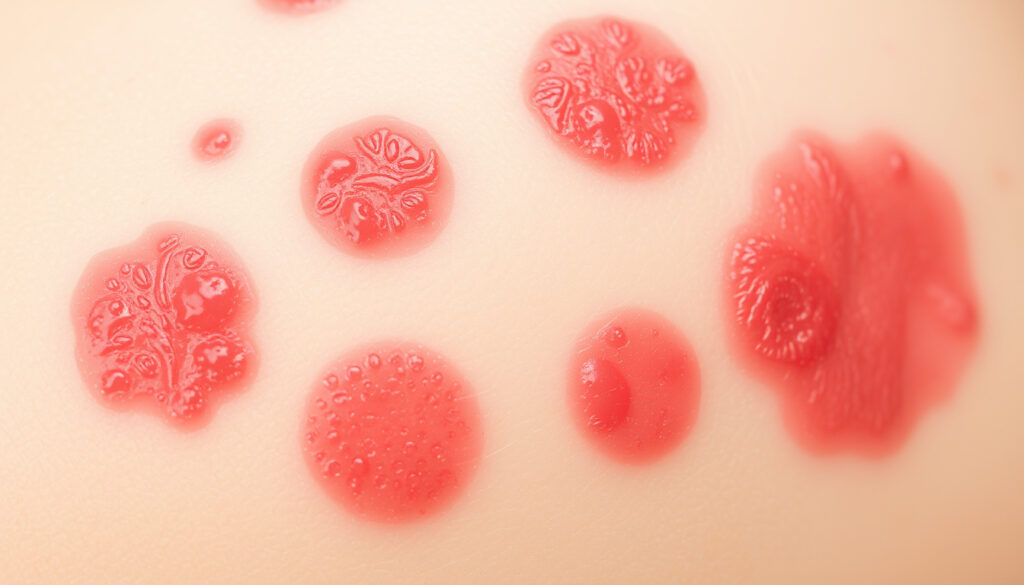
Rashes That Look Like Ringworm But Aren’t: 9 Common Mimics
That red, ring-shaped patch on your arm might look exactly like the ringworm you’ve heard about — but it could be something else entirely. This guide breaks down the nine conditions most likely to fool you, with the clinical clues that separate each one from actual tinea corporis.
Top Mimic Condition: Granuloma Annulare · Ringworm Cause: Fungal Infection · Common Non-Itchy Lookalike: Nummular Eczema · Autoimmune Mimic: Lupus Rash · Cancer-Related Lookalike: Hodgkin’s Lymphoma Rash
Quick snapshot
- Ringworm is a fungal infection; mimics are not contagious (Medical News Today)
- Localized granuloma annulare accounts for 75 percent of cases (AAFP)
- Ringworm responds to antifungal cream in 7-10 days; mimics do not (Medical News Today)
- Exact prevalence rates for mimics without biopsy confirmation
- Whether lymphoma rash can appear without systemic symptoms
- Ringworm clears in 7-10 days with treatment; granuloma annulare may persist for years
- Lupus-related rashes can recur seasonally with sun exposure
- Self-diagnosis is unreliable; see a dermatologist for ring-shaped rashes lasting over two weeks
- A KOH test or biopsy can confirm whether a rash is fungal
The table below contrasts ringworm facts with key mimic attributes to anchor your self-assessment.
| Label | Value |
|---|---|
| Ringworm Transmission | Person-to-person, animals, soil |
| Primary Mimic | Granuloma Annulare (non-infectious) |
| Cancer Link | Hodgkin’s lymphoma can present ring-like |
| Hygiene Myth | Ringworm not caused by poor hygiene |
What rash looks like ringworm but is not?
Ringworm (tinea corporis) is a fungal infection that spreads through direct contact, contaminated surfaces, or infected animals. It produces scaly, itchy rings that can grow and multiply — behavior that most non-fungal mimics simply don’t show. When that ring-shaped patch has smooth, non-scaly borders and no itch, you’re likely looking at one of these common imposters.
Granuloma Annulare
Granuloma annulare presents as ring-shaped, flesh-colored or red spots that are non-scaly and not itchy, distinguishing it from scaly, itchy ringworm. The condition favors the dorsal aspects of extremities with smooth, non-scaly borders. Localized granuloma annulare accounts for 75 percent of cases, with lesions typically 1-5 cm in diameter (AAFP). Granuloma annulare is often misdiagnosed as tinea due to the annular appearance but lacks the characteristic scaling (DermNet NZ). Localized granuloma annulare is most common in children on hands, feet, and elbows with smooth rings (DermNet NZ). Granuloma annulare often resolves spontaneously in 50 percent of cases (AAFP).
Nummular Eczema
Nummular eczema appears as coin-shaped, red, scaly patches that can be itchy but is not fungal, unlike ringworm. The term “nummular” derives from the Latin word “nummulus,” meaning coin-shaped (Clinician.com). Nummular eczema is triggered by bug bites, medications, or metal allergies, causing circular dry, scaly patches. Nummular eczema is coin-shaped papulovesicular erythematous lesions; treat by reducing dryness (AAFP).
Psoriasis Plaques
Psoriasis can produce circular plaques that resemble ringworm, though they typically show silvery scaling and appear on extensor surfaces like elbows and knees. Unlike ringworm, psoriatic plaques are usually symmetric and associated with nail changes or joint symptoms.
Granuloma annulare is benign and non-contagious, but patients often undergo unnecessary antifungal treatment when a dermatologist could confirm the diagnosis with a simple examination.
Misdiagnosis is common with annular lesions — what appears to be ringworm often isn’t, and treatment failure should prompt a professional evaluation rather than extended self-treatment.
How do you tell if a rash is ringworm or not?
The distinction between ringworm and its mimics comes down to a few key clinical features: scaling texture, itch intensity, and how the lesion spreads over time. Ringworm typically shows central clearing with an active, itchy border. Non-fungal mimics often lack this classic pattern.
Key Symptoms Comparison
Ringworm presents with scaly, itchy rings that expand and may ooze, while granuloma annulare shows smooth, non-scaly borders with no itching. Nummular eczema produces coin-shaped patches with scaly texture but typically no central clearing. Subacute cutaneous lupus erythematosus (SCLE) shows red to pink plaques with raised borders and central clearing, often photosensitive (Clinician.com).
Diagnostic Tests
Tinea corporis is diagnosed with KOH microscopy positive for fungus (Clinician.com). Granuloma annulare biopsy confirms diagnosis when not clinically obvious (Goldenberg Dermatology). Lupus diagnosis may require ANA blood tests and skin biopsy (Advanced Food Intolerance Labs).
When to See a Doctor
If a ring-shaped rash doesn’t respond to over-the-counter antifungal cream within two weeks, see a dermatologist. Rashes that are not itchy, not spreading, or have smooth borders rather than scaly edges particularly warrant professional evaluation.
Ringworm clears with antifungal treatment in 7-10 days; mimics do not respond to antifungals. If your rash persists despite treatment, it’s almost certainly not ringworm.
What autoimmune rash looks like ringworm?
Autoimmune conditions can produce annular rashes that closely mimic ringworm, with the most notable being subacute cutaneous lupus erythematosus (SCLE). These rashes have distinctive features that set them apart from fungal infections.
Lupus Rash Features
Subacute cutaneous lupus erythematosus (SCLE) shows red to pink plaques with raised borders and central clearing, often photosensitive (Clinician.com). SCLE presents in annular or papulosquamous form, photosensitive, on exposed surfaces (AAFP). Lupus rashes have finer scale, may scar or cause pigment changes, and are photosensitive (Advanced Food Intolerance Labs). Lupus rashes on sun-exposed areas may scar and show pigment changes (Medical News Today). SCLE patients may fulfill criteria for systemic lupus erythematosus (AAFP).
Other Autoimmune Mimics
Granuloma annulare can be triggered by medications, viral infections, skin trauma, or thyroid disorders — suggesting an immune system component (Derm Doctors NVA). Sarcoidosis can also present with annular skin lesions, though this is less common.
Photosensitivity is a major component of SCLE — if your annular rash worsens with sun exposure and scars or leaves pigment changes, ask your dermatologist about lupus testing.
Because lupus is a systemic condition, skin findings warrant broader evaluation even when dermatologic involvement appears minimal.
What does Hodgkin’s lymphoma rash look like?
While rare, certain cancers can produce skin manifestations that resemble ringworm. Hodgkin’s lymphoma is particularly known for presenting with itchy, red patches that can form ring-like patterns.
Rash Characteristics
Hodgkin’s lymphoma rash typically appears as red, itchy patches that may resemble ringworm but are not fungal. These lesions are not caused by infection but by the lymphoma itself affecting the skin.
The implication: Ring-like skin lesions that resist antifungal treatment and appear alongside systemic symptoms demand hematologic workup regardless of how benign they look.
Associated Symptoms
Lymphoma-related skin rashes often accompany systemic symptoms such as unexplained weight loss, night sweats, or swollen lymph nodes. If a ring-shaped rash appears alongside these warning signs, blood work and imaging may be necessary to rule out hematologic malignancy.
What rashes can mimic ringworm?
Beyond the conditions already covered, several other dermatologic issues can produce circular lesions that look like tinea corporis at first glance. If you’re concerned about skin cancer and brown spots on your skin, you can find more information here: hudkræft brune pletter på huden.
Viral and Bacterial Causes
Pityriasis rosea often begins with a herald patch followed by smaller lesions arranged in a Christmas tree pattern. Lyme disease produces erythema migrans — a bull’s-eye rash that can resemble ringworm but expands rather than stays the same size.
Cancerous Rashes
Beyond Hodgkin’s lymphoma, leukemia can present with skin findings that mimic various rashes. These cancerous rashes may appear as petechiae, bruising, or generalized skin changes rather than classic annular lesions.
Insect Bites
Spider bites can produce circular reactions with central clearing that look remarkably like ringworm. These typically resolve within a week or two and often have a visible puncture mark at the center.
The catch: Assuming every ring-shaped rash is fungal invites weeks of ineffective treatment and delays diagnosis of conditions that require entirely different management.
How to Identify and Treat Ringworm Lookalikes
Getting the right diagnosis means starting the right treatment — or avoiding unnecessary treatment altogether. Here’s how dermatologists systematically approach a ring-shaped rash of uncertain origin.
- Observe the borders: Scaly, raised borders suggest ringworm; smooth borders without scaling suggest granuloma annulare or lupus.
- Check for itching: Ringworm is typically itchy; granuloma annulare usually isn’t.
- Monitor spread: Ringworm expands over days; granuloma annulare lesions tend to remain stable in size.
- Note location: Granuloma annulare favors dorsal hands, feet, and elbows; lupus-related rashes appear on sun-exposed areas.
- Try treatment: If antifungal cream doesn’t improve the rash within two weeks, it’s almost certainly not ringworm.
- Seek diagnosis: A dermatologist can perform KOH microscopy for fungal confirmation or order biopsy for unclear cases.
Confirmed
- Ringworm is a fungal infection spread by direct contact
- Granuloma annulare is benign, non-contagious, and lacks scaling
- Nummular eczema produces coin-shaped, scaly patches
- Lupus-related rashes are photosensitive and may scar
- Ringworm responds to antifungal treatment in 7-10 days
Reportedly unclear
- Exact incidence rates for each mimic without skin biopsy
- Whether granuloma annulare has genuine autoimmune etiology
- How often lymphoma rash appears without systemic symptoms
What this means: The confirmed column is actionable — clinicians can use these facts immediately. The unclear column signals where evidence gaps remain and where patients should understand uncertainty.
Granuloma annulare is often initially misdiagnosed as tinea because of the annular appearance. — DermNet NZ (Dermatology Authority)
The term “annular” stems from the Latin word “annulus,” meaning ringed. — AAFP (Medical Publication)
Nummular, derived from the Latin word “nummulus,” meaning coin shaped. — Clinician.com (Medical Review)
The confusion between ringworm and its mimics isn’t a failure of observation — it’s a limitation of pattern recognition alone. Ring-shaped lesions are visually striking regardless of their cause, and the itchy, scaly version we associate with tinea gets the most attention in popular descriptions. What gets less attention is that dozens of non-fungal conditions produce the same circular geometry, often leaving patients frustrated after weeks of unnecessary antifungal treatment.
For anyone dealing with a persistent ring-shaped rash, the practical path forward is straightforward: give antifungal treatment a fair trial of two weeks, then push for a dermatologist evaluation if nothing improves. The stakes are low for ringworm and high for the autoimmune and, rarely, oncologic conditions that can mimic it. Localized granuloma annulare most commonly affects children and tends to resolve on its own; for adults with widespread lesions, the search for an underlying trigger becomes more urgent. Lupus-related rashes demand systemic evaluation regardless of how minimal the skin involvement appears. And lymphoma — while uncommon — sends skin signals that are easy to dismiss until systemic symptoms have advanced.
For patients with ring-shaped rashes that are smooth, non-itchy, and unmoved by antifungal creams, the choice is clear: stop guessing and get a professional diagnosis, or risk treating the wrong condition for months.
Related reading: What Does Blood in Stool Look Like
int.livhospital.com, centerforderm.com, pmc.ncbi.nlm.nih.gov, internationaldrugmart.com, myacare.com
These mimics like granuloma annulare and nummular eczema often puzzle patients, much as explored in this identification guide with visual aids for better differentiation.
Frequently asked questions
Is ringworm due to poor hygiene?
No. Ringworm is caused by a fungal infection spread through direct contact with infected people, animals, or contaminated surfaces. It has nothing to do with personal cleanliness.
How do you get ringworm?
Ringworm spreads through direct skin-to-skin contact with an infected person or animal, or by touching contaminated objects like towels, clothing, or soil where the fungus can survive.
What are the sneaky signs of lymphoma?
Beyond the characteristic itchy, red patches, lymphoma may present with unexplained weight loss, night sweats, fatigue, or swollen lymph nodes. Skin manifestations can precede systemic symptoms in some cases.
What do leukemia rashes look like?
Leukemia-related skin findings often appear as petechiae (tiny blood spots), bruising, or generalized rashes rather than classic annular lesions. Any unusual skin change alongside fatigue or bleeding warrants medical evaluation.
What does a cancerous rash look like?
Cancerous rashes vary widely but often include persistent, unexplained skin changes that don’t respond to typical treatments, possible itching or pain, and association with systemic symptoms like weight loss or fatigue.
Looks like ringworm but not itchy?
Non-itchy ring-shaped rashes are more likely to be granuloma annulare, lupus-related rashes, or other non-fungal conditions. Ringworm almost always causes noticeable itching.
Viral rash that looks like ringworm?
Pityriasis rosea produces oval or circular patches that can resemble ringworm, though it typically follows a “herald patch” with a Christmas tree distribution. Lyme disease bull’s-eye rash is another viral presentation to rule out.
More related posts
 M. Night Shyamalan Movies: Filmography, Best & Worst Rated
 Howard County Judge Elkin Banned – Supreme Court Misconduct Ruling
 On Becoming a Guinea Fowl: Review, Watch Online & Meaning
 How to Split Screen on Chromebook: Step-by-Step Guide & Shortcuts
 Wisconsin Supreme Court Election Results: Taylor Defeats Lazar
 Who Is the Most Famous Person in the World? (2026)
 What Is Anion Gap? Normal Range, Causes, Symptoms & More
