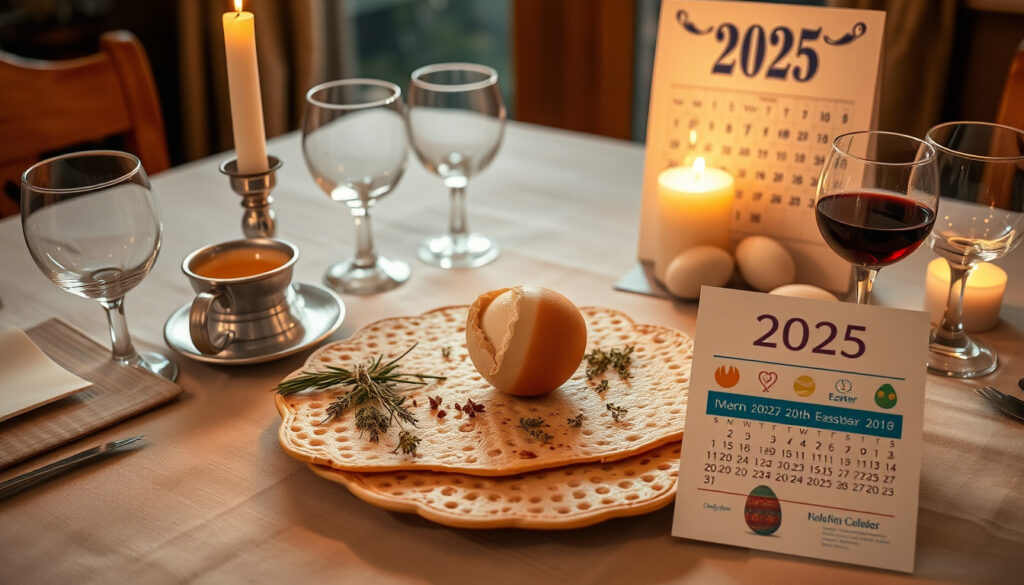
When Is Passover 2025? Dates, Seder & Easter Overlap
If you’ve been wondering whether Easter and Passover land on the same dates this year, you’re in good company — 2025 marks one of those rare years when the two holidays practically brush shoulders, with Easter falling on the very last day of Passover. Knowing exactly when the Seder falls can make the difference between a smoothly planned weekend and a frantic search for matzah at 6 p.m. on Saturday.
Start Date: Evening of April 12, 2025 ·
End Date: Evening of April 20, 2025 ·
Duration: 8 days ·
First Seder: April 12, 2025 ·
Observed in Israel: 7 days
Quick snapshot
- Passover 2025 begins April 12 evening (The Sukkah Store)
- Ends April 20 evening — diaspora 8 days, Israel 7 days (Reform Judaism)
- Biblical date: Nisan 15–22 on Hebrew calendar (Aish.com)
- Why Easter 2025 lands so late in its range (April 20 sits near the upper bound of March 22–April 25)
- Whether specific regional customs in US communities differ meaningfully from general diaspora practice
- Passover 2026: April 1–8 (earlier start, shorter gap from 2025)
- Passover 2027: April 21 start (latest possible window)
- Prepare chametz-free kitchen before April 12 evening
- First Seder April 12, second Seder (diaspora) April 13
- Easter Sunday April 20 coincides with Passover final day
| Fact | Value | Source |
|---|---|---|
| 2025 Start | Sunset April 12 | The Sukkah Store |
| 2025 End | Nightfall April 20 | ABC13 |
| Duration (Diaspora) | 8 days | Reform Judaism |
| Biblical Date | Nisan 15–22 | Aish.com |
| Western Easter 2025 | April 20 | Ray Fowler .org |
| Orthodox Easter 2025 | April 20 | Jewish World Life |
| First Seder | April 12 after nightfall | The Sukkah Store |
| Second Seder (diaspora) | April 13 after nightfall | The Sukkah Store |
| Israel Duration | 7 days | Reform Judaism |
| Western Easter Range | March 22 to April 25 | Ray Fowler .org |
Do Easter and Passover Overlap in 2025?
Easter and Passover share deep lunar roots, which is why they often fall near each other — but they rarely land on the exact same days. In 2025, the two holidays come closer than usual, with Western Easter (April 20) landing on the very last day of Passover in the diaspora.
Easter 2025 date
Western Easter 2025 is April 20. Orthodox Easter also falls on April 20 that year — an unusually synchronized date across traditions that more commonly diverge by a week or more (Jewish World Life calendar data). Easter’s date follows the first Sunday after the first full moon on or after the vernal equinox (March 21), placing it in a window from March 22 to April 25 (Ray Fowler .org).
Overlap reasons
The shared lunar basis means Passover and Easter often track together — Passover falls on the 15th of Nisan in the Hebrew calendar, while Easter aims for the Sunday after the full moon closest to the spring equinox. But solar calendar adjustments and the different algorithms used by Western versus Eastern churches create the divergence (Saint John’s Seminary theological analysis). Orthodox churches also shift Easter to the following Sunday if it would fall directly on Passover, a rule that further separates the dates in some years.
In 2025, Easter coincides with Passover’s final day — not because they follow the same calendar, but because the lunar math happens to line up that way. For non-Jewish observers, this means Passover guests and Easter gatherings won’t compete for the same weekend.
What Day Is Passover Seder 2025?
The first Seder of Passover 2025 is Saturday, April 12, beginning after nightfall. This follows the Jewish tradition of marking the new day from sundown — so while most calendars show April 12, the Seder actually starts as Saturday evening transitions into the night.
First Seder night
The first Seder on April 12 is the main ritual meal of Passover, featuring the Haggadah reading, four cups of wine, and the symbolic plate of foods representing the Exodus story (Reform Judaism observance guide). Matzah takes center stage as the “bread of affliction” commemorating the haste with which the Israelites fled Egypt, before dough had time to rise.
Second Seder
Outside Israel, Jews observe a second Seder on Sunday evening, April 13. This tradition dates to ancient calendar uncertainty — before a fixed calendar was established, communities couldn’t be certain which day the holiday actually began, so two Seders became standard in the diaspora (The Sukkah Store calendar guide). In Israel, only one Seder is held.
The Seder plate itself is symbolic, not meant to be eaten in full. The maror (bitter herbs), charoset (sweet paste), and zeroa (shank bone) each represent a different aspect of the slavery-to-freedom narrative — a ritual that’s remained remarkably consistent for millennia.
What Are the Five Forbidden Foods on Passover?
Passover kitchen rules revolve around chametz — any food product made from wheat, barley, rye, oats, or spelt that has come into contact with water and risen. Beyond the obvious bread and baked goods, chametz hides in many processed foods.
Chametz definition
Chametz includes all leavened products: bread, pasta, cakes, cookies, and cereals. The prohibition is rooted in the Exodus account where the Israelites left Egypt so quickly there was no time for bread to rise. Beyond food, chametz also refers to any product containing these grains in any form — including some medications and cosmetics (Aish.com Hebrew calendar explainer).
Kitniyot debate
Ashkenazi Jews also avoid kitniyot — rice, corn, beans, peas, and lentils — despite these not being chametz. Sephardic and Mizrachi Jewish communities traditionally permit kitniyot, creating a significant difference in Passover cuisine across Jewish populations. Reform Jews often adopt the more permissive approach, focusing primarily on avoiding actual chametz rather than kitniyot (Reform Judaism dietary guidance).
Many “Passover-safe” processed foods still contain allergens or cross-contact warnings. Families with severe allergies should verify each item independently — a product labeled “Kosher for Passover” may still be produced in a facility that processes nuts, dairy, or gluten.
When Is Passover 2025 in Israel?
Passover 2025 in Israel follows the same start date as everywhere else — sunset April 12 — but the observance runs for seven days rather than eight, ending at nightfall on April 19.
Diaspora vs Israel dates
The 7-day observance in Israel reflects the biblical commandment (Exodus 12:15), which prescribes seven days of unleavened bread. The diaspora tradition of an eighth day emerged from rabbinic concern about calendar uncertainty in ancient times — communities outside Israel couldn’t be certain which day was the actual holiday, so they added a safety margin (Reform Judaism observance overview). Reform Jews worldwide often follow the 7-day Israeli pattern regardless of where they live.
Biblical basis
Passover begins on the 15th day of Nisan in the Hebrew calendar, which corresponds to a full moon mid-month in the lunisolar system. Nisan is the seventh month in the biblical calendar but the first month for counting sacred occasions. The holiday commemorates the tenth plague in Egypt, when the Angel of Death passed over homes marked with lamb’s blood while firstborn Egyptians died (Aish.com biblical history).
Should Christians Celebrate Easter or Passover?
Christians and Jews observing holidays that share historical roots raises a natural question: is celebrating Passover appropriate for non-Jews? The answer depends on theological perspective and denominational guidance.
Historical links
The Last Supper, as described in the Gospels, was a Passover Seder — meaning the Christian Eucharist has direct roots in the Jewish ritual meal. The early Christian church originally celebrated Passover alongside Jewish believers before the two traditions diverged. Many Christian churches today acknowledge this connection, with some Messianic Jewish congregations and interfaith Seders that deliberately bridge the traditions (Saint John’s Seminary theological resource).
Modern observance
Most mainstream Christian denominations advise against observing Passover as a religious obligation for Christians, viewing it as a specifically Jewish commandment. However, many churches hold “Passover Seders” as educational or cultural events to deepen understanding of Biblical context, particularly during Holy Week. This distinction — between participating for learning versus religious obligation — is central to most denominational guidance.
Interfaith Seders have grown in popularity in Christian communities, offering participants a tangible connection to the Exodus narrative that underlies themes of liberation central to both traditions. For churches focused on social justice, the Passover narrative of oppression-to-freedom often resonates more immediately than Easter’s resurrection theology.
| Feature | Passover 2025 | Western Easter 2025 | Orthodox Easter 2025 |
|---|---|---|---|
| Start date | April 12 (evening) | April 20 | April 20 |
| End date | April 20 (diaspora) / April 19 (Israel) | April 20 | April 20 |
| Duration | 8 days (diaspora) / 7 days (Israel) | 1 day | 1 day |
| Calendar basis | Hebrew lunisolar (Nisan 15) | Gregorian solar with lunar adjustments | Julian calendar through April 2025, then Gregorian alignment |
| Key ritual | Seder meal (two in diaspora) | Sunday Mass / services | Paschal Vigil, midnight services |
| Overlap in 2025 | Easter falls on Passover’s final day — Western and Orthodox Easter both land on April 20 | ||
| Date range | Fixed to Hebrew calendar | March 22 – April 25 | April 4 – May 8 |
The comparison shows how lunar calendars align in 2025 despite different calculation methods — Western and Orthodox Easter both land on April 20, coinciding with Passover’s final day in the diaspora.
“The first Seder will kick off the festivities on April 12, after nightfall, and for those outside of Israel, the second Seder follows on April 13, after nightfall.”
— The Sukkah Store, calendar guide
“Easter is observed on the first Sunday following the full moon that comes on or after the vernal equinox (March 21).”
— Ray Fowler, astronomical calendar analysis
“Passover is celebrated for either seven or eight days, depending on family and communal custom.”
— Reform Judaism, holiday overview
Related reading: Super Bowl 2025 · 2025 US Government Status
Passover 2025 notably overlaps with Easter 2025 date on April 20, marking a rare shared celebration for Jews and Christians.
Frequently asked questions
What are the three rules of Passover?
The three core Passover observances are: no chametz (leavened products) in the home, eating matzah during the holiday, and recounting the Exodus story at the Seder. These obligations derive directly from biblical commandment and form the minimum framework for observance.
When to wish happy Passover 2025?
The appropriate greeting is “Chag Sameach” (Happy Holiday) or “Chag Kasher V’Sameach” (Happy and Kosher Holiday) throughout the eight days. On the first night, “Good Yom Tov” is also common. The greeting is appropriate from the evening of April 12 through the end of the holiday.
What color to wear on Passover?
White is traditional for the Seder nights, symbolizing purity and the white garments of ancient pilgrims. However, many families have adopted modern approaches and there is no strict requirement — modest, clean clothing appropriate for the holiday meal is the core tradition.
Why do Jews have two refrigerators?
Many Orthodox Jewish households maintain two refrigerators during Passover: one for chametz food (sealed or stored in a designated area) and one cleared entirely of chametz for Passover food. This isn’t a universal practice but is common where Orthodox families observe strict Passover kitchen rules requiring separate chametz-free storage.
When is Passover 2026?
Passover 2026 begins the evening of April 1, 2026, and runs through April 9 in Israel (7 days) or April 9 evening in the diaspora (8 days). First Seder is April 1 after nightfall.
When is Passover in the Bible?
Passover is first observed on the 15th of Nisan (Exodus 12), commemorating the night the Angel of Death passed over marked homes in Egypt. The biblical holiday was a single day, with Unleavened Bread (Chag HaMatzot) following as a separate seven-day festival that became intertwined with Passover over time.
What is a Seder meal?
A Seder is a ritual dinner held on the first two nights of Passover (one night in Israel), structured around 15 specific steps outlined in the Haggadah text. The meal includes four cups of wine, eating matzah, reliving the Exodus narrative, and symbolic foods on a ceremonial plate.
For American families planning holiday gatherings, the 2025 overlap means Easter services and Passover Seders won’t compete for the same weekend — but they do share a common endpoint. Families with mixed heritage or interfaith households should mark April 20 as a day when both communities may be engaged in religious activities, potentially affecting travel and gathering logistics. Booking flights and making restaurant reservations before mid-April is advisable, as hospitality venues often see high demand across both traditions during this week.
More related posts
 The Quick and the Dead (1995): Cast, Meaning & Worth Watching
 What Does ICL Mean? Texting, TikTok, Gen Z Slang & More
 Dawn of the Black Hearts Cover: Facts and History
 Lilo & Stitch Live Action: Release, Cast, Autism & LGBTQ Themes
 Giants vs Broncos Match Player Stats: Historic Comeback
 Nintendo Switch Pro Controller: Is It Worth $70
 Make a Word with These Letters: Free Finder & Unscrambler
 Rashes That Look Like Ringworm But Aren’t: 9 Common Mimics
