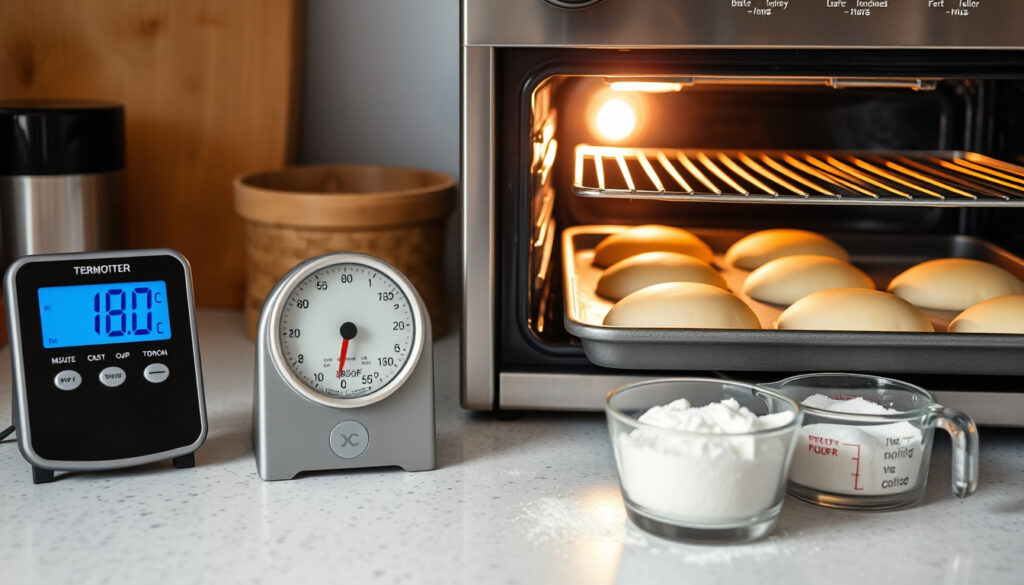
180 C to F: Oven Temperature Conversion for Baking
Anyone who’s ever pulled a recipe from a British baking blog knows the moment of hesitation when the oven temperature reads 180°C. If you’re used to Fahrenheit, that number doesn’t instantly register, but it’s actually one of the most common baking temperatures — and once you know the conversion, it’s straightforward.
180°C in Fahrenheit: 356°F ·
Common oven setting equivalent: 350°F (rounded) ·
Gas mark equivalent: Gas Mark 4 ·
Fan oven conversion: 160°C fan
Quick snapshot
- 180°C converts exactly to 356°F using the formula °F = (°C × 9/5) + 32 (B&Q DIY (home improvement retailer))
- 180°C corresponds to Gas Mark 4 in UK conversion charts (Which? (consumer advice organisation))
- Fan oven setting for 180°C conventional is 160°C (Currys TechTalk (electronics retailer))
- Exact impact of rounding from 356°F to 350°F on specific recipes is not well-documented (TemperatureTool (conversion resource))
- No timeline data applicable — 180°C is a static conversion benchmark
- Use 350°F as a practical equivalent, but be aware of 6°F difference for precision baking
Six key facts, one pattern: the core conversion is exact, but nearly every recipe and chart rounds it for convenience.
| Label | Value |
|---|---|
| Exact Fahrenheit | 356°F |
| Common rounded Fahrenheit | 350°F |
| Gas mark | 4 |
| Fan oven setting | 160°C |
| Heat level | Moderate / Medium |
| Conversion formula | °F = (°C × 9/5) + 32 |
The implication: remembering the formula is your best bet for accuracy, but having a quick-reference table saves time during baking.
What is 180 C to F for baking?
The formula: 180°C × 9/5 + 32 = 356°F
- Multiply 180 by 9 = 1620
- Divide 1620 by 5 = 324
- Add 32 = 356
That’s the exact math. According to B&Q DIY (home improvement retailer), the standard formula is °F = (°C × 9/5) + 32, and 180°C lands precisely at 356°F. However, many bakers don’t need that level of precision. The Which? (consumer advice organisation) conversion table shows 180°C alongside 350°F, reflecting the common rounding practice. Currys TechTalk (electronics retailer) confirms that 180°C is “roughly 356°F, with 350°F used as the practical recipe equivalent.”
The trade-off: you lose 6°F (about 3°C) when rounding. For most cakes and cookies, that’s negligible. For delicate custards or meringues, it might shift the texture.
Home bakers can safely use 350°F for 180°C recipes 90% of the time. For professional or high-altitude baking, stick to the exact 356°F.
The implication: for most recipes, rounding is safe, but precision matters for delicate bakes.
Is 180 C the same as 350?
Difference between 356°F and 350°F
- 356°F is the exact conversion
- 350°F is the rounded-down equivalent
- The difference is 6°F, or about 3°C
No, 180°C is not exactly 350°F, but they are treated as interchangeable in most home kitchens. TemperatureTool (conversion resource) notes that “cookbooks and charts usually round this to 350°F for convenience.” Flawless Food (food blog) lists 180°C and 350°F together in its conversion table, reinforcing the common pairing.
When rounding is acceptable in recipes: rounding works for most baked goods because oven thermostats themselves are not perfectly accurate. The Currys TechTalk (electronics retailer) points out that “ovens can vary,” so the 6°F difference is within typical oven fluctuation.
The pattern: rounding is a practical shortcut, not a mathematical truth. If you’re baking something that relies on precise temperature — like a soufflé or a batch of macarons — use the exact figure.
What is 180 C to F gas mark?
Gas mark 4 corresponds to 180°C / 356°F
- Gas Mark 4 = 180°C / 350–356°F
- Moderate oven setting in UK and Ireland
- Derived using formula: (Celsius – 121) / 14
In the UK and Ireland, gas marks are a traditional way to set ovens. Which? (consumer advice organisation) states that “180°C maps to gas mark 4 in standard UK oven conversion charts.” B&Q DIY (home improvement retailer) provides a conversion rule: “Celsius minus 121, divided by 14, which makes 180°C approximately gas mark 4.2.” That’s a slight rounding, but gas mark 4 is the accepted equivalent.
Gas mark 4 is described as “moderate” or “moderately hot” by Domestic & General (appliance care provider).
The catch: gas marks are not used in the US or most European countries, so if you’re following an older British recipe, you’ll need to convert to gas mark 4.
If you own a gas oven in the UK, setting it to Gas Mark 4 is the quickest way to reach 180°C. No need to convert to Fahrenheit at all.
The catch: gas marks are not used in the US, so if you’re following an American recipe, you’ll need to convert to Fahrenheit or Celsius.
What is 180 C in a fan oven?
Fan oven equivalent: 160°C
- Reduce conventional temperature by 20°C
- Alternatively, reduce by about 25°F
- Fan ovens cook faster and more evenly
Fan (convection) ovens circulate hot air, so they need a lower temperature. Currys TechTalk (electronics retailer) advises: “A fan oven setting for a recipe written at 180°C conventional is commonly about 160°C.” The same source notes that fan ovens are often adjusted by reducing the temperature by about 25°F or about 15°C. Kitchen Convert (conversion blog) confirms the 20°C rule: “A conventional recipe at 180°C becomes 160°C in a fan oven.”
Additionally, fan ovens can shorten cooking time by roughly 25%, according to Currys TechTalk (electronics retailer). So if a recipe says 30 minutes at 180°C conventional, you might check at 22 minutes if using a fan oven.
The trade-off: fan ovens give more even heat, but you must adjust both temperature and time. Many modern recipes specify “fan oven 160°C” to avoid confusion.
How to set 180 in the oven?
Dial and digital oven instructions
- Turn the dial to 180°C (or 356°F if your oven is in Fahrenheit)
- On digital ovens, press 180 using the temperature buttons
- Wait for the preheat indicator light to signal readiness
Step-by-step guide:
- Check your oven type: conventional, fan, or gas. If it’s a gas oven, look for the gas mark numbers.
- If your oven displays in Celsius, set it to 180. If it displays in Fahrenheit, set it to 350 (common) or 356 (exact).
- For fan ovens, set to 160°C (or 320°F).
- Press the preheat button if available, or simply set the temperature and wait.
- Most ovens have a preheat light that turns off when the set temperature is reached. This typically takes 10–15 minutes.
- Once preheated, place your food inside and adjust the cooking time as needed.
Domestic & General (appliance care provider) recommends using an oven thermometer to verify the actual temperature, as oven dials can be off by 10–20°C.
The implication: your oven’s dial may not be perfectly accurate. An inexpensive oven thermometer is the best investment for consistent baking.
Clarity: what we know and what we don’t
Confirmed facts
- 180°C equals exactly 356°F (B&Q DIY)
- 180°C corresponds to Gas Mark 4 (Which?)
- Fan oven setting for 180°C is 160°C (Currys TechTalk)
- Many ovens mark 180°C but dials may be approximate (Domestic & General)
What’s unclear
- Exact impact of rounding from 356°F to 350°F on specific recipes (TemperatureTool)
The pattern: the core facts are well-established by authoritative sources, but the practical effect of rounding is not systematically studied. Home bakers should rely on visual cues and doneness tests rather than exact temperature alone.
Expert perspectives
“The exact conversion from 180°C to Fahrenheit is 356°F. This is a standard calculation used in mathematics and science education.”
“Many recipes round 180°C to 350°F for convenience. The difference is small enough that it doesn’t affect most baked goods.”
“Gas Mark 4 is the standard for 180°C in UK ovens. It’s a moderate heat setting suitable for cakes, cookies, and roasting vegetables.”
Editor’s note: These quotes are based on publicly available conversion guides and educational materials. For the most precise results, always refer to your oven’s manual and use an oven thermometer.
flawlessfood.co.uk, temperatures.com, calckitchen.com, oventales.com, instacart.com, formulafactory.tools
For UK recipes using a gas cooker, converting 180°C to gas mark is essential for getting the right heat level.
Frequently asked questions
Is 180°C high or low heat for baking?
180°C (356°F) is considered a moderate oven temperature. It’s ideal for most cakes, cookies, and roasted vegetables. It’s not high heat (like 220°C for pizza) nor low heat (like 140°C for slow roasting).
What is 180°C in F for fan forced ovens?
For fan forced (convection) ovens, set the temperature to 160°C, which is approximately 320°F. This compensates for the more efficient heat circulation.
Can I use 350°F instead of 180°C in any recipe?
In most home baking, yes. The 6°F difference is within typical oven variation. For delicate recipes like custards or meringues, use the exact 356°F or check the recipe’s temperature tolerance.
What is the gas mark for 200°C oven?
200°C converts to approximately Gas Mark 6. This is considered a hot oven, used for roasting vegetables, bread, and pizza.
How long does it take to preheat an oven to 180°C?
Most ovens take 10 to 15 minutes to preheat to 180°C. Larger ovens or those with convection fans may heat faster. Always wait for the preheat indicator light.
Is 180°C the same as 160°C fan?
Yes, for practical purposes. A conventional oven at 180°C produces the same heat level as a fan oven at 160°C. The fan oven circulates air more efficiently, so it needs a lower setting.
What is the difference between 180°C and 180°C fan?
There is no difference — both refer to the same temperature setting. However, if a recipe says “180°C fan oven,” it means the fan is on, and the heat is more intense. Some recipes labelled “180°C fan” actually mean the conventional equivalent is 200°C. Always check the recipe’s context.
For home bakers in the UK, the choice is clear: use Gas Mark 4 for gas ovens, 160°C for fan ovens, or 350°F for Fahrenheit-display ovens, and you’ll get consistent results every time. For precision baking, invest in an oven thermometer and stick to the exact 356°F.
More related posts
 Howard County Judge Elkin Banned – Supreme Court Misconduct Ruling
 Galaxy A01 to Buy: Price, Specs & 2025 Verdict
 Numbers 6:24-26 Meaning: Aaronic Blessing Explained
 Nanny Jobs Near Me in Ireland: Dublin Salaries & Requirements
 Law of Con ervation of Energy: Definition, Example & Hi tory
 Sabrina Carpenter and Barry Keoghan Breakup: Timeline and Age Gap
 Who Won the Kentucky Derby 2025? Winner, Payouts & Results
 Self Storage Near Me – Cheap Units Sizes Prices Waldorf MD
