What Is Natural Selection? Definition, Process & Examples
You probably learned about natural selection in school — maybe a dusty textbook diagram of moths turning dark during the Industrial Revolution. But the real story is more vivid than any diagram suggests: a giraffe stretching its neck across generations, bacteria outsmarting antibiotics within weeks, birds on remote islands crafting entirely new beak shapes to crack unfamiliar seeds. At its heart, natural selection explains how life adapts, one generation at a time.
Core Mechanism: Differential survival and reproduction · Proposed By: Charles Darwin · Key Outcome: Adaptation and evolution · Primary Source: Natural History Museum
Quick snapshot
- More adapted organisms survive (Natural History Museum)
- Differential reproduction drives change (UC Berkeley)
- Heritable traits spread through populations (University of Utah)
- 1831: Darwin joins HMS Beagle voyage (YouTube documentary)
- 1859: On the Origin of Species published (YouTube documentary)
- Industrial Revolution: Peppered moth adaptation observed (YouTube documentary)
- Antibiotic resistance accelerates as selection pressure increases (Sciencing)
- Climate change creates new selection pressures on wildlife (Natural History Museum)
The table below maps key concepts to their authoritative definitions, showing how natural selection serves as the engine of evolutionary change.
| Label | Value |
|---|---|
| Definition | Mechanism of evolution – Natural History Museum |
| Process | Species adapt to environment – Sciencing |
| Fitness Basis | Differential reproduction – YourDictionary |
| Outcome | Population change over time – Live Science |
| Survival Rule | Best adapted reproduce – Biology Online |
What is natural selection in simple terms?
Natural selection is the process where organisms better adapted to their environment survive and reproduce more successfully than those less suited to their surroundings. The key insight is that “better adapted” doesn’t mean strongest or fastest — it means organisms whose traits give them any edge in their specific environment, whether that’s camouflage, disease resistance, or beak shape for cracking seeds.
Core definition from sources
The Natural History Museum defines natural selection as “the process where organisms better adapted to their environment tend to survive and produce more offspring.” This simple definition carries enormous weight: it’s the mechanism that explains how life diversifies from common ancestors over deep time.
Charles Darwin and Alfred Russel Wallace independently developed this theory, though Darwin’s 1859 publication of On the Origin of Species cemented natural selection as the central explanation for evolution (Sciencing). Darwin’s genius was recognizing three patterns that together create evolutionary change.
Key components
- Variation: Individuals within a population differ from one another — in size, color, behavior, disease resistance, or any heritable trait.
- Inheritance: Many of these variations are passed from parents to offspring through genes.
- Differential reproduction: Because populations produce more offspring than can survive, individuals with advantageous variations are more likely to reproduce and pass those traits on.
According to UC Berkeley’s Understanding Evolution, “If you have variation, differential reproduction, and heredity, you will have evolution by natural selection as an outcome.” The mechanism is that straightforward.
How to explain natural selection to a kid?
Kids understand fairness instinctively, so frame natural selection as nature’s way of saying, “Which animals are best set up for this particular job?” Think of it like a class where every student gets a slightly different tool for a building challenge — some get hammers, some get screwdrivers — and then nature says, “Show me what you can build.”
Simple analogies
- The animal rescue story: Imagine a litter of turtles heading from their nest to the ocean. Birds pick off the slower, more visible ones. The survivors aren’t necessarily “better turtles” — they’re just the ones whose shells and instincts gave them an edge on that particular night.
- The seed spread: Plants in a windy field make thousands of seeds. Seeds that float farther get to new soil. Seeds that germinate faster in cold weather win in northern climates. Nature “selects” through differential survival, not conscious choice.
Kid-friendly examples
The peppered moth story works well for curious children. During Britain’s Industrial Revolution, soot turned tree bark dark. Dark-colored moths survived better because birds couldn’t spot them against the dark bark. Once pollution cleared, light moths dominated again — an entire species shifted its color in response to changing conditions (YourDictionary). Kids grasp this because they can picture the trees changing color.
“Survival of the fittest, where fitness was defined as reproductive success.”
— Charles Darwin, via Sciencing
Avoid the phrase “survival of the fittest” without explanation. Kids often interpret “fittest” as “strongest” or “fastest.” Clarify that it means “best suited to the specific conditions” — a slow, camouflaged moth is fitter than a fast, visible one when birds are hunting.
What is Darwin’s theory of natural selection?
Darwin’s theory rests on a deceptively simple observation: life varies, and nature filters who survives to pass those variations on. He didn’t know about genes when he proposed the theory in 1859, yet his framework holds up against modern genetics.
Darwin’s observations
The HMS Beagle voyage began in 1831 and lasted five years. During this time, Darwin collected specimens and made observations that would reshape biology. In the Galapagos Islands, he noticed that finches on different islands had different beak shapes — each adapted to local food sources (Sciencing). This was a crucial clue that species weren’t fixed; they changed in response to their environments.
Three key observations underpinned Darwin’s framework: variation in traits within populations exists, many of these traits are heritable, and organisms produce more offspring than the environment can support, creating competition for limited resources (YourDictionary). The combination of these three facts meant that advantageous traits would accumulate over generations.
The golden rule concept
Darwin’s theory doesn’t posit a ladder of progress or a destination. It describes a process of local adaptation. The giraffe’s long neck isn’t “better” in any absolute sense — it’s better for reaching high leaves in environments where low vegetation is scarce. A longer neck becomes disadvantageous where agility matters more. Natural selection is always context-dependent.
“Survival of the fittest” was actually coined by philosopher Herbert Spencer, who associated it with Darwin’s work. Darwin himself clarified that fitness meant reproductive success — not physical strength or combat ability (Biology Online). An organism that produces three surviving offspring while others produce none is “fitter,” regardless of size or speed.
Darwin’s theory predates modern genetics by decades. He worked with phenotypic variation — observable traits — and recognized that something heritable was being passed along. When genes were discovered, Darwin’s framework fit precisely: mutations create variation, natural selection filters it, and heritable traits spread through populations.
What are natural selection examples?
Real-world examples span every branch of life. Some unfold over millennia; others happen fast enough to observe directly. The diversity of examples is itself evidence of natural selection’s power: the same basic mechanism produces moth camouflage, bird beaks, bacterial drug resistance, and whale blowholes.
Real-world cases
- Peppered moths: In industrial England, soot darkened tree bark. Dark-colored moths survived better because predators couldn’t see them. After pollution controls reduced soot, light-colored moths regained their advantage. This shift occurred within decades — observable evidence of selection in action (YourDictionary).
- Darwin’s finches: The Galapagos Islands host multiple finch species, each with beak shapes matched to their food sources. Ground finches crack seeds with thick, powerful beaks. Tree finches use thinner beaks for insects. These differences evolved from a common ancestor within the last few million years (Sciencing).
- Antibiotic resistance: Bacteria multiply rapidly — some species double every 20 minutes. When antibiotics are introduced, most bacteria die, but resistant strains survive and reproduce. Within days, an entire population can shift toward resistance. This is evolution visible in real time, and it’s a public health crisis (Sciencing).
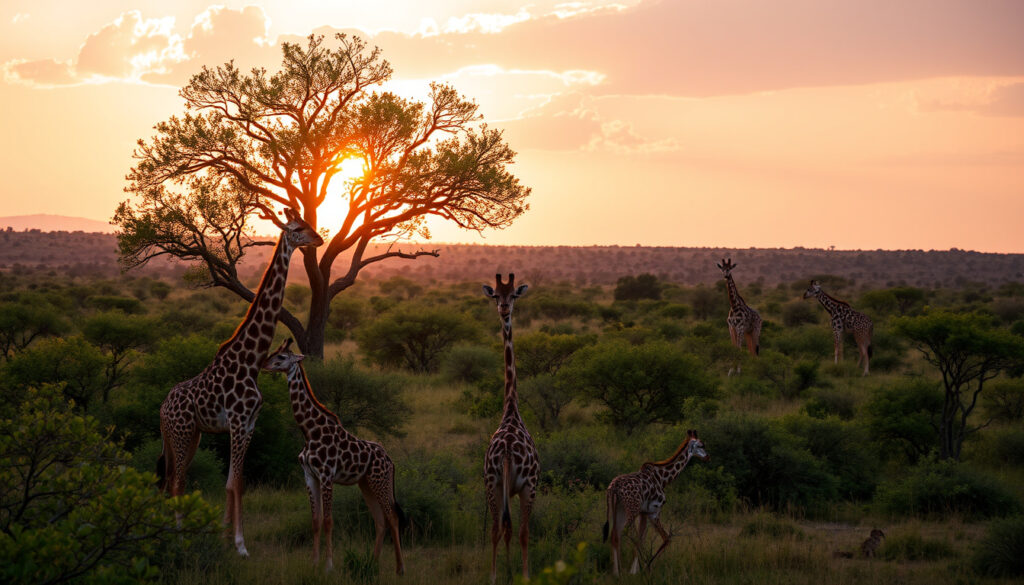
- Giraffes: Longer necks allowed giraffes to access higher leaves, giving them an advantage in environments where low vegetation was scarce or competed over. This trait persists across generations because giraffes with longer necks left more surviving offspring (Natural History Museum).
In biology and humans
The peppered moth example demonstrates rapid adaptation during the UK’s Industrial Revolution. Field mustard plants in California evolved shorter growing seasons to survive drought conditions (YourDictionary). Whale evolution shows how gradual adaptation can reshape an entire body plan: nostrils repositioned as blowholes through stepwise selection over millions of years (Live Science).
In humans, lactase persistence is a striking example. Most mammals (and most human populations historically) lose the ability to digest milk after weaning. But in populations with long histories of dairy farming, adults who could digest milk had a nutritional advantage — and lactase persistence spread through those populations.
Natural selection produces adaptations that can become vulnerabilities. Camouflage helps moths avoid predators — until pollution changes what “camouflage” means. A trait perfectly suited to one environment can become a liability when conditions shift. Selection optimizes for current conditions, not future ones.
What is the process of natural selection?
The process of natural selection follows a recognizable sequence. It doesn’t require intention, guidance, or foresight — just heritable variation plus differential survival. Understanding the steps clarifies why the mechanism is so powerful and why it operates constantly, in every population, on every trait that varies.
Steps involved
- Variation exists: Every population contains individuals with different traits — size, color, behavior, metabolism, disease resistance. This variation comes from random mutations in DNA.
- Competition occurs: Populations produce more offspring than the environment can support. Not all individuals survive to reproduce.
- Selection filters: In a given environment, some traits confer advantages. Individuals with those traits are more likely to survive long enough to reproduce.
- Trait inheritance: Because many traits are heritable, survivors’ offspring tend to inherit the advantageous traits.
- Population shifts: Over generations, advantageous traits become more common. This is evolution — a change in trait frequency within a population.
According to UC Berkeley, natural selection requires three conditions: variation in traits, differential reproduction (some variants leave more offspring), and heredity (traits are passed to offspring). Genetic drift and migration are other evolution mechanisms alongside natural selection, but selection specifically favors adaptive traits.
How it leads to evolution
Natural selection is one of the primary mechanisms of evolution. It doesn’t create new traits from scratch — mutation does that. Selection determines which new traits spread. A trait that arises through mutation might persist, spread, or vanish depending on whether it confers a survival or reproductive advantage in the current environment.
The implication is that evolution isn’t a linear progression toward “better” organisms. It’s a branching, context-dependent process. A trait that’s advantageous in one environment might be neutral or harmful in another. This is why we see such diversity: different populations face different selection pressures, producing different adaptations.
The steps of natural selection explained
Here is the natural selection process broken down into actionable steps, with concrete examples for each stage:
Step 1: Generate heritable variation
Random mutations create new genetic variants in a population. These mutations occur constantly, most are neutral or harmful, but occasionally one creates a trait that influences survival or reproduction.
Example: A mutation in a bacterial population might confer resistance to a particular antibiotic.
Step 2: Create competition for resources
Populations tend to produce more offspring than the environment can support. Food, space, and mates become limited. Not all individuals can survive to reproductive age.
Example: A field of plants produces thousands of seeds, but only a fraction will find suitable soil and conditions to germinate.
Step 3: Apply selection pressure
Environmental pressures — predators, disease, climate, resource scarcity — determine which traits are advantageous. Individuals whose traits match current conditions have higher survival rates.
Example: In an environment with antibiotic treatment, bacteria with resistance mutations survive while susceptible strains die off.
Step 4: Favor differential reproduction
Survival alone isn’t enough — individuals must successfully reproduce and pass advantageous traits to offspring. “Fitness” in evolutionary biology means reproductive success, not physical strength.
Example: Peacocks with larger, brighter tails attract more mates and leave more offspring, spreading the trait even though larger tails might increase predation risk.