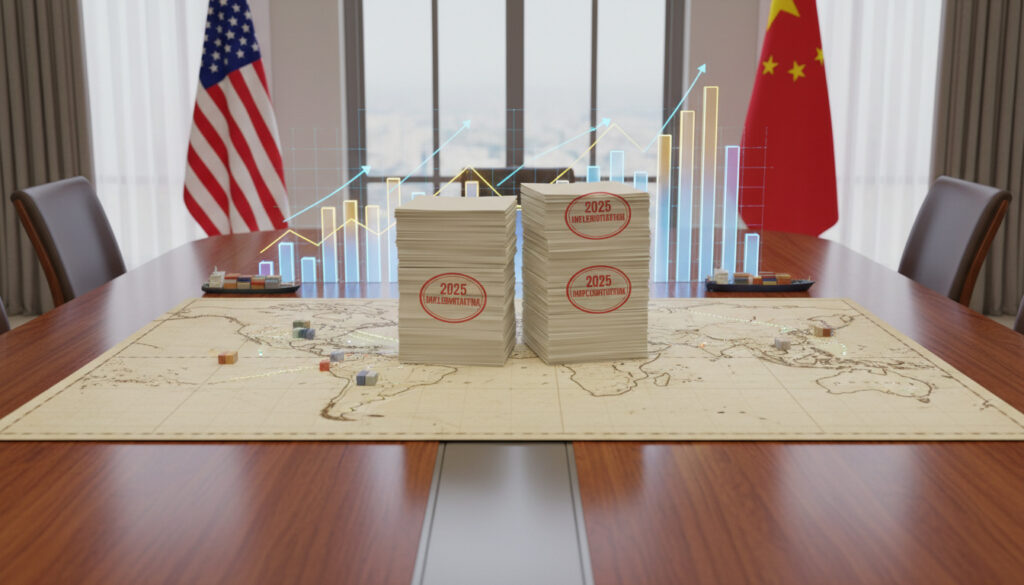
US-China Trade Talks – Current Status 2025 Implementation
Trade negotiations between Washington and Beijing have entered an implementation phase following the de-escalation frameworks established throughout 2025. After years of tit-for-tat tariffs initiated in 2018 and intensified under targeted sectoral hikes in 2024, the current administration initiated reciprocal reductions and commitments on critical mineral exports.
The United States now applies a 30% tariff rate on Chinese goods, reduced from prior levels, while China maintains a 10% rate on American imports. These rates follow the Geneva agreement of May 12, 2025, which implemented a 90-day pause on additional barriers and amendments to de minimis rules for low-value shipments.
Recent diplomatic exchanges focus on compliance with rare earths provisions and agricultural export frameworks rather than negotiating a comprehensive Phase 2 agreement. Official readouts describe the dialogue as candid and constructive, though no specific deadlines bind the current working plans.
What Is the Current Status of US-China Trade Talks?
Active work plans govern rare earths licensing and tariff maintenance without new deadline commitments.
US rates at 30% and Chinese rates at 10% following the 2025 reduction agreements.
Chinese export license reviews for rare earths and US agricultural purchase frameworks.
Cumulative tariffs cover $550 billion in Chinese goods and $185 billion in US goods.
- May 2025 Breakthrough: Geneva meeting produced reciprocal tariff cuts totaling 115 percentage points.
- June 2025 Framework: London talks established implementation protocols signed June 24, announced June 26.
- Rare Earths Provisions: China confirmed export license reviews June 27, with general licenses issued by MOFCOM.
- De Minimis Adjustments: Rule amendments for low-value shipments took effect May 14, 2025.
- Presidential Engagement: Direct Trump-Xi calls on June 5 and October Busan meeting advanced specific commitments.
- Phase 1 Legacy: Historical $40-50 billion annual agricultural purchase commitments remain referenced but implementation reviews concluded.
| Metric | Current Status | Effective Date |
|---|---|---|
| US Tariff Rate on Chinese Goods | 30% | Post-Geneva May 2025 |
| Chinese Tariff Rate on US Goods | 10% | Post-Geneva May 2025 |
| Rare Earths Commitment | Export license reviews pledged | June 27, 2025 |
| Total US Tariffs Imposed (Historical) | $550 billion Chinese goods | Cumulative since 2018 |
| Total Chinese Tariffs Imposed (Historical) | $185 billion US goods | Cumulative since 2018 |
| De Minimis Rule Amendments | Effective for low-value shipments | May 14, 2025 |
| Phase 1 Agricultural Purchases | Historical commitment $40-50 billion annually | 2019-2020 framework |
When Are the Next US-China Trade Talks Scheduled?
Immediate Diplomatic Prospects
No specific date has been confirmed for the next formal negotiation round. Recent official statements reference a “work plan between now and the meeting between the presidents,” suggesting preparatory discussions continue without fixed summits.
The most recent high-level engagement occurred in October 2025 in Busan, where Trump and Xi met to advance tariff arrangements and rare earths compliance commitments. This followed the June 10 London talks that established the current implementation framework.
Historical Negotiation Patterns
Previous phases demonstrated irregular scheduling contingent on presidential discretion. The June 5, 2025 phone call between Trump and Xi preceded the London framework by five days, while the October Busan meeting consolidated Geneva commitments made five months prior.
Diplomatic readouts explicitly avoid committing to specific dates, emphasizing flexible working plans rather than calendar-driven summits. This approach contrasts with the rigid Phase 1 review schedules of 2020.
What Are the Main Issues in US-China Trade Talks?
Tariff Reciprocity and Structural Rates
The central mechanism involves maintaining reduced reciprocal rates while preventing re-escalation. The 30% US and 10% Chinese rates represent a reduction from the triple-digit levels threatened during the 2024 tit-for-tat disputes. Ongoing reviews monitor compliance with these Geneva-established figures.
Technology Transfer and Rare Earths Controls
Critical minerals dominate current technical discussions. China committed to export license reviews for rare earths materials, while the United States agreed to lift corresponding countermeasures. The June 2025 arrangement specifically addresses supply chain bottlenecks for these strategically essential resources.
Intellectual Property and Phase 1 Legacy
Historical Phase 1 provisions strengthened IP protections and targeted forced technology transfer. While no Phase 2 agreement has materialized, current talks reference these 2019 commitments regarding cyber intrusions and theft as baseline expectations.
Under the June 2025 framework, Beijing pledged systematic export license reviews for rare earths in exchange for Washington lifting specific countermeasures. The Ministry of Commerce subsequently issued general export licenses to facilitate compliance.
No comprehensive Phase 2 agreement has been finalized or scheduled. Current arrangements provide temporary relief and implementation protocols rather than permanent structural resolutions to technology transfer or subsidy disputes.
Who Are the Key Players in US-China Trade Negotiations?
Presidential Leadership
Donald Trump and Xi Jinping drive strategic decisions through direct engagement. Their June 5 phone call initiated the London framework, while the October Busan meeting advanced specific tariff and rare earths commitments. This top-down approach contrasts with the delegated technical negotiations of earlier phases.
Historical Negotiating Teams
Phase 1 implementation involved Vice Premier Liu He representing Beijing, while US Trade Representative Robert Lighthizer and Treasury Secretary Steven Mnuchin handled Washington’s 2019-2020 portfolio. Current frameworks rely less on designated agency principals and more on direct executive coordination.
The Office of the United States Trade Representative and China’s Ministry of Commerce maintain technical oversight, though the shift from Phase 1 working groups to 2025 presidential diplomacy reduces their public negotiating roles.
How Did US-China Trade Relations Reach the Current State?
- : Phase 1 deal announced, delaying tariffs on $250 billion in Chinese goods; Beijing committed to $40-50 billion annual US agricultural purchases and intellectual property protections. Source
- : Vice Premier Liu He, USTR Lighthizer, and Treasury Secretary Mnuchin affirmed Phase 1 progress during implementation review calls.
- : Biden administration doubled tariffs on Chinese solar cells and tripled rates on lithium-ion EV batteries, initiating three-year phased increases on steel and aluminum.
- : Finalized hikes to 100% on electric vehicles, 50% on solar cells, and 25% on batteries, critical minerals, steel, and aluminum, effective September 27.
- : Geneva meeting reduced US tariffs to 30% and Chinese tariffs to 10%, implementing a 90-day pause on barriers.
- : Trump-Xi phone call established parameters for implementation talks.
- : London talks agreed on the implementation framework for rare earths and tariff maintenance.
- : Signed deal on rare earths exports for US countermeasures lift; China confirmed export license reviews June 27.
- : Trump-Xi meeting in Busan advanced commitments on tariff arrangements and rare earths compliance.
What Is Definite and What Remains Uncertain?
Established Facts
- Tariff rates fixed at 30% (US) and 10% (China) post-Geneva
- Rare earths deal signed June 24, 2025, with MOFCOM issuing general licenses
- De minimis amendments effective May 14, 2025
- Phase 1 agricultural commitments ($40-50B) historically implemented
- No comprehensive Phase 2 agreement finalized
Pending Questions
- Specific date for next presidential meeting
- Duration of current 30%/10% tariff rates beyond temporary frameworks
- Complete resolution timeline for technology transfer disputes
- Structural enforcement mechanisms for rare earths compliance
What Historical Context Defines Current Negotiations?
The 2018 initiation of trade hostilities established a baseline of $550 billion in US tariffs and $185 billion in Chinese countermeasures covering reciprocal trade volumes. Phase 1 (2019-2020) temporarily stabilized agricultural flows but left structural IP and subsidy disputes unresolved.
The Biden era (2021-2024) shifted from broad negotiations to targeted escalation, imposing 100% tariffs on electric vehicles and 50% on solar cells by September 2024. The current framework represents a reversal from these unilateral hikes toward the Jack of All Trades Meaning, Origin and History of negotiated reciprocity, emphasizing executive-level deal-making over bureaucratic phased implementation.
What Do Official Sources Confirm?
Recent exchanges have been candid, in-depth, and constructive, focusing on tariff arrangements and the implementation of consensus including the Busan rare earths provisions.
— Diplomatic readouts, China Briefing, Early 2026
China pledged to conduct export license reviews for rare earths related items while the US committed to lift countermeasures.
— Framework confirmation, Time Magazine, June 2025
What Are the Potential Outcomes and Global Impacts?
Current frameworks provide temporary tariff relief and rare earths supply stability rather than permanent structural resolution. The 2025 deals reduced import costs from 2024 peaks, supporting trade resumption in agricultural and energy sectors while maintaining Jack of All Trades Meaning, Origin and Modern Debate on whether comprehensive Phase 2 negotiations will materialize. Global supply chains continue adapting to the phased implementation of de minimis rules and critical mineral licensing requirements.
Frequently Asked Questions
What caused the initial US-China trade tensions?
The 2018 trade war began over disputes regarding forced technology transfer, cyber intrusions, intellectual property theft, and chronic trade deficits, leading to successive tariff waves on $550 billion in Chinese goods and $185 billion in US goods.
How do current talks affect global supply chains?
The 2025 tariff reductions and rare earths licensing commitments ease immediate bottlenecks in critical minerals and agricultural trade, though phased implementation of de minimis rules creates adjustment periods for low-value shipment sectors.
Are the US and China close to a comprehensive new agreement?
No Phase 2 agreement has been finalized. Current arrangements provide temporary frameworks and implementation protocols rather than permanent resolutions to technology transfer or structural trade imbalances.
What was the Phase 1 deal?
Announced October 11, 2019, Phase 1 delayed tariffs on $250 billion in goods while China committed to $40-50 billion in annual US agricultural purchases, strengthened IP protections, and currency guidelines.
What distinguishes the 2025 negotiations from previous rounds?
The 2025 framework relies on presidential-level calls and meetings rather than working group negotiations, producing reciprocal tariff cuts (115 percentage points) and specific rare earths licensing commitments absent from Phase 1.
Which sectors face remaining tariff burdens?
While reduced from 2024 peaks, electric vehicles, solar cells, batteries, steel, aluminum, and critical minerals maintain elevated rates under the current 30%/10% reciprocal structure.
More related posts
 Make a Word with These Letters: Free Finder & Unscrambler
 Map of Middle East: Countries, Capitals, Facts & Maps
 Taylor Swift Merch Store: Official Guide to Avoid Fakes
 Can Dogs Eat Coconut? Vet-Approved Safety, Benefits & Risks
 Naked and Famous Cocktail: Recipe, Ingredients & History
 House of the Dragon Season 3: Release Date & News
 Best Questions to Ask a Girl: 200+ Deep, Flirty & Funny
 Butcher Shop Near Me: Prices, Cuts & Best Options
