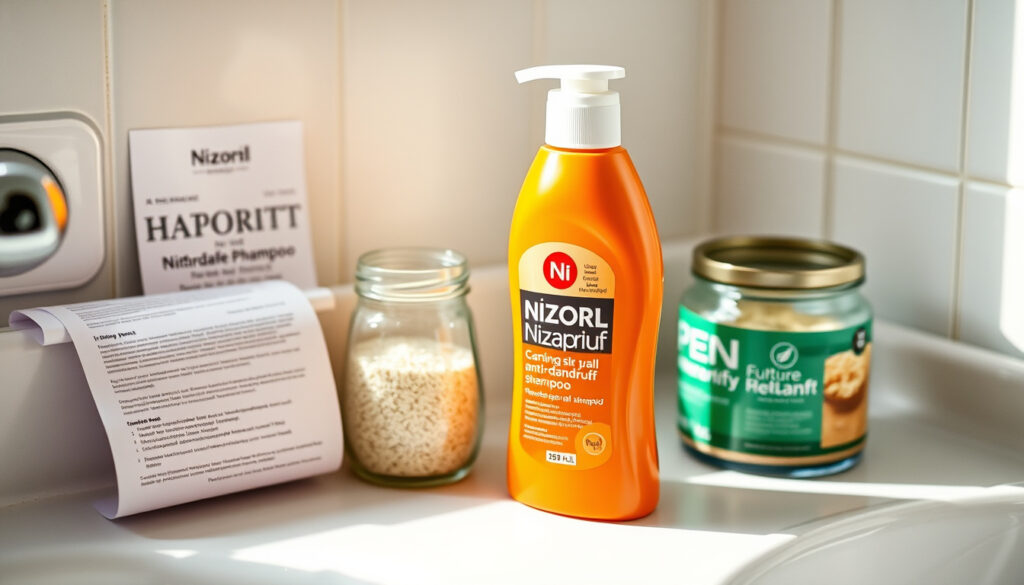
Nizoral Anti-Dandruff Shampoo: How to Use & Buy in Ireland
Few things disrupt your morning routine quite like noticing a snowfall of flakes on your dark shirt. If you’ve tried regular shampoos and come up short, you’ve probably heard of Nizoral — the medicated shampoo that tackles dandruff at its fungal source.
Active ingredient in Nizoral: Ketoconazole 1% or 2% ·
Improvement seen in: 2 weeks ·
Available strengths: 1% (OTC) and 2% (prescription) ·
Availability in Ireland: Yes – Boots, McCabes, Healthwave, PharmaDirect ·
Common usage frequency: Twice weekly for maintenance ·
Most reported side effects: Scalp dryness, irritation, oily or dry hair
Quick snapshot
- Nizoral contains ketoconazole, an antifungal agent that reduces Malassezia yeast (FDA (U.S. health authority)).
- 2% concentration is more potent than 1% for stubborn dandruff and seborrhoeic dermatitis (HPRA (Irish medicines regulator)).
- Daily use not recommended for extended periods — may cause scalp dryness or irritation (Patient.info (UK patient information site)).
- Direct causal link between Nizoral and hair thinning is not well documented (Cleveland Clinic (U.S. hospital system)).
- Optimal frequency for hair loss prevention remains uncertain — evidence is mixed (RxList (consumer drug reference)).
- Long-term safety of 2% daily use in self-treatment is not established (Nizoral Shampoo UK (brand guidance)).
- Whether temporary shedding indicates long-term thinning is unclear (Cleveland Clinic (U.S. hospital system)).
- The role of Nizoral in hair regrowth is not an approved indication (HPRA (Irish medicines regulator)).
- Visible improvement in dandruff typically seen within 2 weeks of twice-weekly use (Patient.info (UK patient information site)).
- If no improvement after 4 weeks, consult a doctor (HPRA (Irish medicines regulator)).
- Maintenance schedule: every 1–2 weeks to prevent recurrence (Patient.info).
- If daily use is causing irritation, switch to alternate-day washing with a gentle shampoo (Nizoral Shampoo UK (brand guidance)).
- For hair loss concerns, consider consulting a dermatologist before moving to 2% prescription (Cleveland Clinic (U.S. hospital system)).
- Irish shoppers can find Nizoral at Boots, McCabes, Healthwave, and PharmaDirect (pharmacy retail). (Nizoral Shampoo UK (brand guidance))
6 key specs, one takeaway: Nizoral is a targeted antifungal shampoo, not a general cleanser — its strength and frequency should match your scalp condition.
| Attribute | Details |
|---|---|
| Active ingredient | Ketoconazole |
| Available strengths | 1% (OTC) and 2% (prescription) |
| Availability in Ireland | Yes – Boots, McCabes, Healthwave, PharmaDirect |
| Indication | Treatment and prevention of dandruff and seborrhoeic dermatitis |
| Typical use frequency | Twice weekly |
| Time to visible results | 2 weeks |
What will happen if I use Nizoral shampoo every day?
Using Nizoral daily may clear flakes faster but often backfires with scalp dryness, irritation, or greasy rebound. The HPRA (Irish medicines regulator) warns that overuse can make hair or scalp dry or oily — exactly what you’re trying to fix.
Recommended frequency of use
- For dandruff treatment: twice weekly for 2–4 weeks (Patient.info (UK patient information site)).
- For maintenance: every 1–2 weeks to prevent recurrence (Patient.info).
- If you miss a dose, don’t double up — just resume the regular schedule (FDA (U.S. health authority)).
Signs of overuse
- Increased scalp irritation, redness, or burning sensation (Cleveland Clinic (U.S. hospital system)).
- Abnormal hair texture or colour changes, especially in bleached hair (Hims (consumer health review)).
- Scalp pustules or oiliness — a possible sign the skin barrier is disrupted (RxList (consumer drug reference)).
Alternating with regular shampoo
Many dermatologists recommend using Nizoral twice weekly and a gentle moisturising shampoo on the other wash days. This routine keeps the scalp clean without stripping natural oils. The Nizoral brand UK guidance supports this approach to minimise irritation.
The implication: daily use is rarely necessary — 2–3 times a week is the sweet spot for most people. If you need more frequent washing, alternate with a non-medicated shampoo.
Who should not use Nizoral shampoo?
Nizoral seems straightforward, but several groups need a doctor’s go‑ahead first — especially pregnant women, young children, and anyone with eczema or open wounds on the scalp.
Contraindications and precautions
- People allergic to ketoconazole or any ingredient in the formula should avoid it (FDA (U.S. health authority)).
- Do not apply on broken, inflamed, or eczematous scalp — the skin barrier is too compromised (FDA label).
- The HPRA Summary of Product Characteristics includes pregnancy and lactation warnings: use only if clearly needed and under medical advice.
Allergic reactions to ketoconazole
Although rare, severe reactions such as itching, swelling of the face or throat, and difficulty breathing require immediate care. The HPRA patient leaflet advises stopping the product and seeking medical help at the first sign of allergic response.
Age restrictions
Nizoral is not recommended for infants and very young children without paediatrician approval. The product’s safety and efficacy in children under 12 have not been fully established in clinical trials (Patient.info (UK patient information site)).
What this means: if you have a sensitive scalp, skin condition, or are pregnant, a quick chat with your GP or pharmacist can save you from unnecessary side effects.
Is Nizoral 1% or 2% better for hair loss?
Hair loss is one of the most common reasons people seek out Nizoral — but the evidence that it regrows hair is weaker than the evidence that it controls dandruff. The strength you choose depends on your goal.
How Nizoral may affect hair loss
Nizoral’s active ingredient ketoconazole has shown anti-androgen properties in lab studies, meaning it may block the hormone DHT that contributes to male pattern baldness. However, most human data comes from pilot studies, not large trials. The Cleveland Clinic (U.S. hospital system) notes that ketoconazole shampoo can cause hair loss as a side effect in some users, making the overall picture complicated.
Comparing 1% and 2% concentrations
2% has stronger anti‑androgen action and is often prescribed off‑label for hair loss alongside minoxidil. 1% is sufficient for dandruff control without a prescription and carries a lower risk of irritation. A 2025 review by Hims (consumer health review) summarises that both strengths need consistent use for at least 6 months to see a difference in hair density.
4 differences, one split: 1% for dandruff, 2% for hair loss adjunct — but neither is a standalone hair‑growth treatment.
| Factor | Nizoral 1% (OTC) | Nizoral 2% (prescription) |
|---|---|---|
| Strength | 10 mg/g | 20 mg/g |
| Availability in Ireland | Over‑the‑counter at pharmacies | Prescription only (or imported) |
| Primary use | Mild dandruff | Stubborn dandruff, seborrhoeic dermatitis, off‑label hair loss |
| Anti‑androgen effect | Weak | Moderate |
| Risk of irritation | Low | Higher |
The pattern: start with 1% unless a dermatologist recommends otherwise. Stronger isn’t always smarter — irritation can set back your hair goals.
Clinical evidence and expert opinions
A 2025 Hims article notes that while some users report less shedding, the effect is modest compared to established hair‑loss meds. The HPRA leaflet does not list hair regrowth as an indication — it’s approved only for dandruff and seborrhoeic dermatitis.
The trade‑off: 2% may offer additional benefits for hair loss, but it comes with higher odds of scalp irritation. A balanced approach is to use 2% under medical supervision while tracking any side effects.
What are the negative effects of Nizoral?
Most side effects are mild and temporary, but they can mimic the problem you’re trying to solve — which is why many people stop treatment too early.
Common side effects
- Scalp irritation, itching, or stinging at the application site (Cleveland Clinic (U.S. hospital system)).
- Dry skin or increased oiliness of hair and scalp (RxList (consumer drug reference)).
- Abnormal hair texture (dry, brittle, or colour‑faded in treated hair) – especially in bleached strands (Hims (consumer health review)).
- Rare: scalp pustules or localised rash (Biomedicus (clinical summary)).
Does Nizoral cause thinning hair?
The HPRA patient leaflet (Irish medicines regulator) lists hair loss as a possible local side effect, but it’s not well understood. Many users report temporary shedding in the first few weeks as the scalp adjusts — this may be telogen effluvium triggered by irritation, not permanent thinning. The Cleveland Clinic classifies hair loss as a rare side effect. If shedding persists beyond 4 weeks, consult a dermatologist.
When to see a doctor
Stop use and seek medical advice if you experience severe rash, swelling, breathing difficulty, or if scalp irritation worsens (HPRA (Irish medicines regulator)). Also see a doctor if dandruff has not improved after 4 weeks — there may be an underlying condition like psoriasis or contact dermatitis.
The pattern: side effects are usually manageable by adjusting frequency, using conditioner, or switching to a lower strength. Ignoring them can lead to unnecessary scalp damage.
How to tell if dandruff is fungal?
Not all flaking is fungal — and using an antifungal shampoo on a non‑fungal scalp can make things worse. Knowing the difference saves you weeks of trial and error.
Signs of fungal dandruff (Malassezia)
- Greasy, yellowish flakes that stick to the scalp and hair (Patient.info (UK patient information site)).
- Itching that feels deep or recurring — often worse in warm, humid conditions.
- Flakes accompanied by mild redness or inflammation on the scalp.
Difference from other scalp conditions
Scalp psoriasis produces thick, silvery plaques, not greasy flakes. Contact dermatitis (often from hair products) causes weeping or blistering. Eczema tends to be more diffuse and very itchy. The Cleveland Clinic (U.S. hospital system) recommends seeing a dermatologist if you’re unsure — they can take a skin scraping to confirm fungal infection.
When Nizoral is appropriate
Nizoral’s antifungal action works specifically against Malassezia yeast, the most common cause of dandruff and seborrhoeic dermatitis. If your flakes are dry, white, and powdery (as in simple dry scalp), a moisturising shampoo may be a better first step. The Nizoral brand UK guidance suggests trying the shampoo for 2 weeks — if symptoms don’t improve, the cause may not be fungal.
Why this matters: using Nizoral on non‑fungal dandruff can dry out the scalp and worsen flaking. The quick test? If your flakes are greasy and yellowish, it’s likely fungal — Nizoral is the right tool.
How to use Nizoral shampoo (step‑by‑step)
Correct application makes a real difference in both efficacy and comfort. Here’s the routine backed by the Cleveland Clinic (U.S. hospital system) and Patient.info (UK patient information site).
- Wet your hair and scalp thoroughly with warm water.
- Apply enough Nizoral shampoo to cover the scalp area — about a tablespoon for short hair, more for longer hair.
- Massage gently into the scalp for 30 seconds, working up a lather.
- Leave the shampoo on for 3–5 minutes (use a timer — rinsing too soon reduces efficacy).
- Rinse thoroughly with warm water.
- Repeat steps 2–5 for the second application if directed (2% prescription may require a double wash).
- Use twice weekly for 2–4 weeks, then reduce to every 1–2 weeks for maintenance.
After rinsing, you can use a mild conditioner on your hair ends if needed — avoid applying conditioner directly to the scalp.
The catch: skipping the 3‑minute soak is the most common mistake. Ketoconazole needs contact time to penetrate the scalp and kill yeast.
Confirmed vs. unclear: separating fact from guesswork
Confirmed facts
- Nizoral effectively reduces Malassezia yeast (FDA, HPRA).
- 2% concentration is more potent than 1% for dandruff (HPRA).
- Daily use not recommended for extended periods (Patient.info, HPRA).
- Improvement typically seen in 2 weeks (Patient.info).
- Available OTC in Ireland at major pharmacies (Boots, McCabes, Healthwave, PharmaDirect).
What’s unclear
- Direct causal link between Nizoral and permanent hair thinning (Cleveland Clinic, RxList).
- Optimal frequency for hair loss prevention (evidence is mixed).
- Long-term safety of 2% daily use in self‑treatment (HPRA does not support it).
- Whether temporary shedding indicates long-term thinning (Cleveland Clinic).
- The role of Nizoral in hair regrowth is not an approved indication (HPRA).
The implication: rely on confirmed facts when choosing treatment, and treat unclear claims as secondary considerations.
What experts and sources say
“Apply to wet hair, leave on 3–5 minutes, then rinse thoroughly.”
Cleveland Clinic (U.S. hospital system)
“Clinically proven to treat the cause of dandruff, not just the symptoms.”
Nizoral official website UK (brand)
“Visible results can be seen in 2 weeks.”
“If symptoms do not improve after 4 weeks, seek medical advice.”
HPRA Package Leaflet (Irish medicines regulator)
These sources reflect a range of authority levels, from regulatory bodies to consumer guides.
Pros and cons at a glance
Upsides
- Clinically proven antifungal action against Malassezia.
- Two strengths allow tailoring to severity.
- Affordable and widely available OTC in Ireland.
- Can be used long‑term for prevention.
Downsides
- Daily use can cause irritation, dryness, or oiliness.
- May cause temporary shedding or hair texture changes.
- Not effective for non‑fungal dandruff.
- 2% requires a prescription in Ireland (or import).
The balance: Nizoral’s benefits outweigh its downsides for fungal dandruff, but it’s not a one-size-fits-all solution.
Comparison: Nizoral vs. other dandruff shampoos
Six brands, one decisive factor: Nizoral is the only widely available OTC shampoo that targets the fungal root cause rather than just removing flakes.
| Shampoo | Active ingredient | Mechanism | Best for |
|---|---|---|---|
| Nizoral (ketoconazole) | Ketoconazole 1% / 2% | Antifungal | Fungal dandruff, seborrhoeic dermatitis |
| Head & Shoulders | Zinc pyrithione / Selenium sulfide | Antimicrobial | Mild dandruff, daily use |
| Neutrogena T/Gel | Coal tar | Anti‑proliferative | Psoriasis, stubborn scaling |
| Ducray Kertyol | Oleic acid, urea | Keratolytic | Thick flakes, very dry scalp |
| T/Sal | Salicylic acid | Exfoliant | Flake removal, scalp buildup |
| Selsun Blue | Selenium sulfide | Antimicrobial | Oily dandruff |
The takeaway: Nizoral stands apart because it treats the yeast directly. If you’ve tried zinc or coal tar without success, Nizoral is the logical next step.
Specs comparison: Nizoral 1% vs. 2% (prescription)
7 specs, one story: the main difference is potency and availability — 2% requires a doctor’s sign‑off but delivers stronger antifungal action.
| Specification | Nizoral 1% (OTC) | Nizoral 2% (Rx) |
|---|---|---|
| Ketoconazole concentration | 10 mg/g | 20 mg/g |
| Indication (approved) | Dandruff, seborrhoeic dermatitis | Dandruff, seborrhoeic dermatitis |
| Typical use frequency | Twice weekly | Twice weekly (medical supervision) |
| Contact time | 3–5 minutes | 3–5 minutes |
| Prescription needed in Ireland? | No | Yes (HPRA‑authorised) |
| Anti‑androgen effect | Low | Moderate |
| Common side effect risk | Mild irritation | Moderate irritation, dryness |
The implication: start with 1% unless you have persistent dandruff or a specific hair‑loss goal — then see a doctor about stepping up to 2%.
Frequently asked questions
Can Nizoral be used on colored or chemically treated hair?
Yes, but it may cause colour fading, especially in bleached or blonde hair. The Hims review (consumer health review) notes that ketoconazole can alter hair colour over time. Use a colour‑protecting conditioner on your ends after rinsing.
How long does a 100ml bottle of Nizoral last?
If used twice weekly with about 5–10 ml per wash, a 100ml bottle lasts approximately 10–20 weeks — around 3–4 months.
Is Nizoral safe for pregnant or breastfeeding women?
The HPRA Summary of Product Characteristics advises using Nizoral during pregnancy only if clearly needed. Limited absorption through the scalp means risk is low, but consult your doctor before starting.
Can Nizoral be used for beard dandruff?
Yes. Patient.info (UK patient information site) states ketoconazole shampoo can be used on other hairy areas like the beard. Apply sparingly and rinse thoroughly to avoid dryness.
Does Nizoral interact with other hair products?
No known serious interactions, but using multiple medicated or exfoliating products on the same day may increase irritation. Space out treatments by at least 24 hours.
Should I use conditioner after Nizoral shampoo?
Yes — use a gentle conditioner on the hair lengths only, avoiding the scalp. This helps counteract potential dryness without diluting the antifungal effect (Cleveland Clinic (U.S. hospital system)).
Can Nizoral 2% be bought over the counter in Ireland?
No. The 2% strength is a prescription‑only medicine in Ireland, authorised by the HPRA (Irish medicines regulator). Some online pharmacies may supply it with a valid prescription.
Related reading
For more on skin and scalp health, check out our guide to Stress Bumps on Fingers: Causes, Treatments, and Home Remedies and our comparison of the Best Free Online Pill Identifier tools.
More related posts
 What Is RCS on iPhone – iOS 18 Features Guide
 What Does Poison Oak Look Like? Rash & Treatment Guide
 San Antonio Spurs vs Orlando Magic Match Player Stats (Feb 1)
 Lilo & Stitch Live Action: Release, Cast, Autism & LGBTQ Themes
 How Many Ounces in a Pound – Conversion Tables and Key Facts
 Palm Springs Surf Club: Opening, Prices, Events & Reviews
 The Walking Dead Cast: Salaries and Survivors
 Small Business Insurance Ireland: Types, Costs & Quotes
