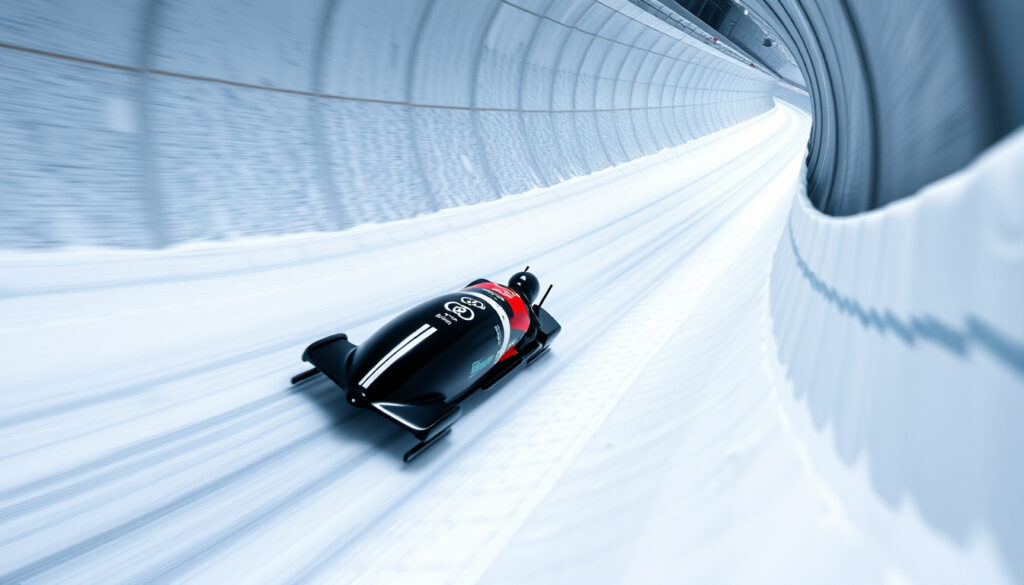
How Do Skeleton Athlete Steer That Thing? No Steering Wheel
If you’ve watched skeleton at the Olympics and wondered how athletes steer those tiny sleds at 80 mph without so much as a joystick, you’re not alone. The answer lies in subtle body shifts—shoulder torque, knee pressure, and weight distribution—that turn a fixed-runner sled into a precision instrument.
Typical skeleton sled weight (without athlete): 33–43 kg (73–95 lbs) ·
Maximum combined weight (sled + athlete): 115 kg (253 lbs) for men, 92 kg (203 lbs) for women ·
Steering mechanism type: None – body weight and shoulder torque ·
Top speed in competition: Up to 130 km/h (80 mph)
Quick snapshot
- Mechanical steering devices are banned by IBSF rules (International Bobsleigh & Skeleton Federation rulebook).
- Runners remain fixed – no wires, ropes, or pulleys (IBSF 2025 International Skeleton Rules).
- Shift weight to the side you want to turn (NBC Olympics (Olympic broadcast partner)).
- Apply pressure with shoulders and knees (IBSF YouTube – The Anatomy of Skeleton (official federation educational video)).
- After the finish, raise head and drag toes to slow down (RToddKing – The Rules and Techniques of Skeleton Racing (explanatory blog)).
- No brakes allowed during the timed run (IBSF rules).
- The exact micro‑movement sequence varies among athletes – no single standard technique is documented by research.
- Whether some sleds have slight runner asymmetry that aids steering is not publicly confirmed.
These specifications define the equipment and performance envelope for Olympic skeleton competition.
| Attribute | Details |
|---|---|
| Steering method | Body weight, shoulder torque, foot/knee pressure |
| Sled weight (empty) | 33–43 kg (73–95 lbs) |
| Maximum total weight (men/women) | 115 kg (253 lbs) / 92 kg (203 lbs) |
| Top speed reached | 130 km/h (80 mph) |
| Track length | 1,200–1,500 m (0.75–0.93 mi) |
| Governing body | International Bobsleigh & Skeleton Federation (IBSF) |
How do skeleton athletes steer?
There is no steering wheel, joystick, or rope on a skeleton sled. Instead, steering relies entirely on torque from the head and shoulders, combined with precise shifts of body weight. Athletes shift their weight to the inside of the turn and apply downward pressure with knees and feet to initiate direction changes. The sled’s runners are fixed—no mechanical device is allowed.
An athlete steering a skeleton sled is essentially a human gyroscope: tiny weight shifts at 80 mph produce big directional changes. The margin for error is measured in hundredths of a second.
Role of body weight in steering
- Weight transfers to the inside of a turn; pressing down with the left shoulder turns the sled left, right shoulder turns right (IBSF YouTube – The Anatomy of Skeleton (official federation educational video)).
- The head is lifted slightly to unweight the front runners, making the sled more responsive.
- Knees press against the sled for extra leverage.
Using shoulders and feet to change direction
- In big corners, athletes may turn a foot sideways and drag it on the ice to create friction.
- The rear of the runners has a grippier, knife-like edge; the front is smoother. Manipulating edge engagement via body angle steers the sled.
Micro‑adjustments vs. major steering moves
- Because skeleton is a high-speed sliding sport, large motions are counterproductive. Athletes aim to be as straight and smooth as possible.
- Effective steering at high speed means tiny inputs produce large changes—a fraction of a degree can mean the difference between a clean line and a wall.
The implication: The same body that sprints at the start becomes the only steering mechanism for the entire run. There is no backup system.
Is there a steering mechanism on a skeleton sled?
Officially, no. The IBSF rules explicitly state that no steering mechanism is allowed on a skeleton sled. The Cresta toboggan, a related sliding sport, also has no steering or brakes. By contrast, bobsled uses a pulley-and-rope system, and luge athletes steer exclusively with leg pressure and body shifts (NBC Olympics – Skeleton 101).
A sport that hits 130 km/h has zero mechanical controls. The only “device” is the athlete’s proprioception—knowing exactly where every muscle is in space at every moment.
Official IBSF rules on sled construction
- The sled frame must be made of steel and the runners of high-grade steel. No modifications that create a mechanical steering advantage are permitted.
- Rules cover safety-related equipment: helmets, suits, and sled dimensions.
Comparison with bobsled and luge control systems
- Bobsled: Driver uses a steering wheel connected to ropes and pulleys that turn the front runners.
- Luge: Athletes sit on a sled and use leg pressure to flex the runners—no hand controls.
- Skeleton: Face-down, no direct controls—pure body mechanics (Wikipedia – Skeleton (sport) (community-maintained reference)).
Why this matters: The absence of mechanical steering makes skeleton technically harder to control than bobsled or luge. Every athlete is their own mechanic.
How do sliders control a skeleton sled?
Control begins at the start. The race begins with a sprint push-start, after which the athlete mounts the sled and continues in a prone, head-first position. Once on the sled, the athlete steers by leaning, pressing with shoulders, and shifting knees.
Starting push and momentum
- The push start generates initial speed; runners are straight at this point.
- After mounting, the athlete gets into a tight aerodynamic tuck—chin low, arms alongside the sled.
Body movements during the descent
- Left turn: press left shoulder into the sled, lift head slightly, shift weight left.
- Right turn: mirror movements (RToddKing – The Rules and Techniques of Skeleton Racing (explanatory blog)).
Braking – how skeleton racers stop
- To slow down after the finish, athletes raise their head, drag toes, or use a small rubber brake on some sleds.
- No brakes are allowed during the timed run – only after crossing the finish line.
The trade-off: The speed that wins medals also makes stopping a challenge. Athletes must plan their deceleration as carefully as their steering.
How do you steer when doing skeleton?
Here is a step-by-step breakdown of the steering process used by competitive skeleton athletes, based on coaching guides from the British Bobsleigh & Skeleton Association (BBSA) (national governing body for the sport in the UK) and official IBSF materials.
Step‑by‑step steering process
- Start in a relaxed, balanced tuck. Tension reduces control.
- Approach a turn – spot the exit. Eyes lead the weight shift.
- Press the shoulder on the side of the turn. For a left turn, press left shoulder into the sled deck.
- Lift the head slightly to transfer weight forward and unload the rear runners.
- Press knees into the sled for extra leverage and fine-tune direction.
- Hold the line – avoid overcorrecting. Small adjustments are more effective.
Common mistakes and corrections
- Too stiff: A cramped body position reduces the sled’s ability to respond. Relaxed, balanced position improves steering.
- Over-steering: Aggressive weight shifts can cause the sled to slide up the wall or lose speed. Micro‑adjustments are key.
What sounds simple on paper takes years of practice. Even Olympic athletes admit they are constantly learning how tiny angle changes affect the sled’s trajectory at different speeds.
What this means for beginners: The same fundamental technique works at 30 km/h and 130 km/h—but the margin for error shrinks dramatically. Practice on flat tracks before attempting a full ice run.
What is the skeleton technique for steering?
The formal technique, as described by the BBSA, revolves around weight shift and shoulder torque. Athletes often practice on a flat track or a simulator to learn weight transfer before ever hitting an Olympic track. Steering effectiveness depends heavily on speed; at high speed, tiny inputs cause large changes, so the athlete must be extremely precise.
The BBSA technique breakdown
- Weight shift: The primary input. Move your center of mass to the inside of the turn.
- Shoulder torque: Rotate the upper body to press the edge of the sled into the ice.
- Knee action: Press one knee into the deck to initiate turning, especially in sharper corners.
Training drills for weight shift
- Drills on a flat wooden sled simulate the weight transfer without the speed.
- Video analysis and force plates help athletes measure how much weight they shift and where they place pressure.
The pattern: Steering in skeleton is less about brute force and more about finesse. The best athletes make it look effortless because they have automated the micro-movements through thousands of runs.
What we know for sure vs. what’s unclear
Confirmed facts
- Skeleton sleds have no mechanical steering mechanism – confirmed in IBSF rules.
- Steering is achieved through athlete body weight and shoulder torque (NBC Olympics).
- Athletes use knee and foot pressure to fine‑tune direction.
What’s unclear
- The exact micro‑movement sequence varies among athletes – no single standard technique is documented by research.
- Whether some sleds have slight runner asymmetry that aids steering is not publicly confirmed.
Athlete perspective: how racers describe it
“You steer by moving your body weight. You press your shoulder down, move your knee a little, and the sled responds. It’s like steering a bike by leaning, only much faster and on ice.”
— NBC Olympics interview with skeleton athlete (Olympic broadcaster)
“The runners are fixed. There is no wheel. The only way to change direction is to shift your weight and use your shoulders. It’s all about feel.”
— British Bobsleigh & Skeleton Association technique guide (national governing body)
“In the big corners, sometimes I drag my foot on the ice to help the sled rotate. You do whatever it takes to stay on line.”
— IBSF – The Anatomy of Skeleton (official federation video)
The implication is clear: skeleton steering is a learned, adaptive skill, not a fixed formula. Each athlete develops their own subtle variations.
Related reading: Who Won the Super Bowl 2026? Seahawks Beat Patriots 29-13 · 2026 NFL Mock Draft: Latest Picks and Predictions
Frequently asked questions
Can skeleton athletes steer after they start?
Yes – steering is continuous from the moment they mount the sled until the finish. After the push start, they steer exclusively by body movements.
How do skeleton racers stop without brakes?
After crossing the finish line, athletes raise their head, drag their toes, and some sleds have a small rubber brake at the back. Braking is not allowed during the timed run.
Is there a difference in steering between men’s and women’s skeleton?
No fundamental difference – both use the same body-weight technique. Athletes of any gender must master shoulder torque and knee pressure. The only difference is the maximum combined sled+athlete weight (115 kg for men, 92 kg for women).
Do skeleton athletes use their arms to steer?
No. Their arms remain alongside the body to maintain an aerodynamic tuck. Steering is done through the shoulders, torso, and legs.
What happens if a skeleton athlete cannot steer correctly?
They may hit a wall, lose speed, or be disqualified for dangerous driving. Poor steering can cause crashes, especially at speeds above 100 km/h.
Are skeleton sleds custom‑made for each athlete?
Yes – the sled is tailored to the athlete’s height, weight, and preference, but all must comply with IBSF specifications. No mechanical steering modifications are allowed.
How do luge athletes steer compared to skeleton?
Luge athletes sit on a sled and steer by pressing their legs against the runners to flex them. Skeleton athletes lie face-down and steer with shoulder and knee pressure. Both lack mechanical controls, but the body positions differ.
More related posts
 When Is Passover 2025? Dates, Seder & Easter Overlap
 How Much Do Truck Drivers Make? 2025 Salary Guide (US & Ireland)
 IRS Fresh Start Program: Eligibility & How It Works
 What Time Is It in France? Current Local Time & Time Zone Info
 Alison Oliver Movies and TV Shows: Full Filmography & Bio
 Why Does My Phone Say SOS? Fix SOS Only Mode
 Parking Garage Near Me: Dublin & Cork Price Guide
 Love Island Reunion 2025: Date, Time, and Where to Watch
